MinuteRead
30 min
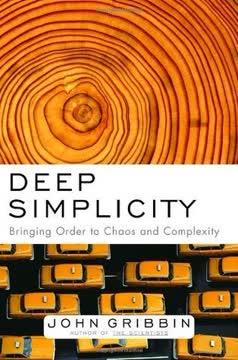
Book summary
by John Gribbin
Premium summary · Opens in the app · 30 min read
For centuries, science operated on a straightforward assumption: understand the parts, and you will understand the whole. If you could describe the motion of every atom, predict the orbit of every planet, and map the behavior of every particle, you could in principle explain everything. This was the dream of Newtonian mechanics, a clockwork universe where the present state of things determined the future with perfect precision.
**Author:** John Gribbin **Estimated Reading Time:** 42 minutes
- Why simple rules can generate astonishing complexity in nature - How chaos theory reveals order hidden within apparent randomness - What fractals teach us about the structure of coastlines, lungs, and galaxies - How systems naturally organize themselves into critical states - Why life may be an inevitable consequence of physical laws - How networks shape everything from ecosystems to economies
This book is for anyone who has ever wondered how a universe governed by a handful of simple physical laws can produce the breathtaking complexity of a rainforest, the unpredictable turbulence of weather, or the intricate wiring of a human brain. It is for readers who sense that the apparent chaos of the world conceals a deeper order, and who want to understand the scientific principles that connect earthquakes, evolution, and the rise and fall of civilizations.
For centuries, science operated on a straightforward assumption: understand the parts, and you will understand the whole. If you could describe the motion of every atom, predict the orbit of every planet, and map the behavior of every particle, you could in principle explain everything. This was the dream of Newtonian mechanics, a clockwork universe where the present state of things determined the future with perfect precision. The dream was powerful. It drove remarkable advances in physics, chemistry, and biology. But it also carried a hidden flaw, one that only became apparent when scientists began to look closely at systems that refused to behave like well-oiled clocks. Consider the weather. The equations governing atmospheric motion are known. They are based on fundamental physics: the behavior of gases, the transfer of heat, the rotation of the Earth. And yet, despite supercomputers and satellite data, weather forecasts remain reliable only for a few days. Beyond that horizon, predictions collapse into uncertainty. Consider the stock market. Every trader acts according to understandable motives: fear, greed, calculation, information. Yet the collective behavior of markets produces wild fluctuations that no individual could predict or control. Consider life itself. A single fertilized cell divides and differentiates into a complex organism with specialized organs, intricate structures, and emergent behaviors. The instructions are encoded in DNA, a molecule built from four simple chemical bases. How does such complexity arise from such simplicity? John Gribbin's central insight in *Deep Simplicity* is that these puzzles share a common answer. The complicated behavior of the world we see around us, including the living world, is merely surface complexity arising out of deep simplicity. The universe is not fundamentally complicated. It is built from simple rules that, when applied repeatedly through feedback and iteration, generate complexity that appears irreducible but is actually the inevitable consequence…
Continue reading in the MinuteRead app
Get the complete 30-minute summary of Deep Simplicity
Get the complete summary in the appSimple rules, applied repeatedly through feedback, generate complex behavior.
Chaos is deterministic but unpredictable. The butterfly effect limits long-term prediction.
Fractals are self-similar shapes found throughout nature, from coastlines to lungs.
Complex systems naturally evolve toward a critical state, where events of all sizes occur.
The edge of chaos is where complexity flourishes. Life operates at this boundary.
Evolution proceeds in punctuated equilibrium: long periods of stability interrupted by brief bursts of change.
"Deep Simplicity" is a strong fit if you want practical ideas around science, physics, philosophy, especially themes like simple rules, applied repeatedly through feedback, generate complex behavior; chaos is deterministic but unpredictable. the butterfly effect limits long-term prediction. The MinuteRead summary distills these concepts into a focused read, whether you're deciding whether to buy the book or applying its lessons at work.
John R. Gribbin is a renowned British science writer and astrophysicist. As a visiting fellow in astronomy at the University of Sussex, he has authored numerous books on a wide range of scientific topics. Gribbin's work spans quantum physics, human evolution, climate change, cosmology, and biographies of prominent scientists. His ability to convey complex scientific concepts to a general audience has made him a respected figure in science communication. In addition to his non-fiction work, Gribb…
View all summaries by John GribbinContinue Reading
Access the complete 30-minute summary and thousands more nonfiction books in the MinuteRead app.

Continue reading the complete summary in the MinuteRead app.