MinuteRead
30 min
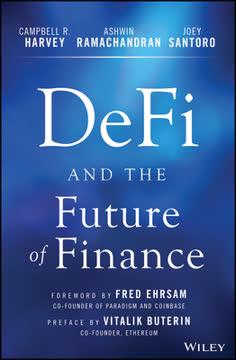
Book summary
Premium summary · Opens in the app · 30 min read
The global financial system is one of humanity's most impressive achievements. It enables billions of people to store value, access credit, invest in productive enterprises, and manage risk across vast distances and time horizons. Yet for all its sophistication, the system rests on a foundation that has remained largely unchanged for centuries. It depends on centralized institutions: banks, brokerages, clearinghouses, and regulators. These institutions act as trusted intermediaries, standing bet
**Author:** Campbell R. Harvey
**Estimated Reading Time:** 45 minutes
**What You'll Learn:**
- Why decentralized finance represents a fundamental rebuild of the financial system - How blockchain technology and smart contracts eliminate the need for intermediaries - The core building blocks that make DeFi applications possible - How lending, trading, and synthetic assets work in a decentralized world - The real risks that accompany the promise of DeFi - What the future of finance may look like as this technology matures
**Who This Book Is For:**
This book is for anyone who wants to understand the most significant transformation in finance since the invention of double-entry bookkeeping. Whether you are an investor trying to navigate the emerging landscape of digital assets, a finance professional concerned about the disruption of traditional business models, a technologist curious about the capabilities of smart contracts, or simply a curious reader who wants to understand what all the excitement is about, this book provides a clear and rigorous framework for understanding decentralized finance.
The global financial system is one of humanity's most impressive achievements. It enables billions of people to store value, access credit, invest in productive enterprises, and manage risk across vast distances and time horizons. Yet for all its sophistication, the system rests on a foundation that has remained largely unchanged for centuries. It depends on centralized institutions: banks, brokerages, clearinghouses, and regulators. These institutions act as trusted intermediaries, standing between parties to every financial transaction. This arrangement has produced remarkable stability in many developed economies. But it has also created profound problems. Centralized control means that a small number of institutions wield enormous power over who can participate in the financial system and under what terms. Limited access means that billions of people around the world remain excluded from basic financial services. Inefficiency means that simple transactions can take days to settle and cost significant fees. Lack of interoperability means that value cannot move freely between different financial platforms. And opacity means that customers often have little visibility into how their money is actually being managed. These are not minor inconveniences. They are structural flaws that impose real costs on individuals, businesses, and entire economies. Consider the simple act of sending money across borders. In the traditional system, an international wire transfer can take three to five business days to complete. It may pass through multiple correspondent banks, each taking a fee and adding delay. The sender has no visibility into where the money is at any given moment. The recipient may not know when the funds will arrive. And the entire process depends on the solvency and cooperation of institutions that neither party controls. Now consider the billions of people who…
Continue reading in the MinuteRead app
Get the complete 30-minute summary of DeFi and the Future of Finance
Get the complete summary in the appDeFi rebuilds finance on decentralized infrastructure, eliminating the need for centralized intermediaries.
The five problems of traditional finance are centralized control, limited access, inefficiency, lack of interoperability
Blockchain solves the double-spending problem without requiring trust in a central authority.
Smart contracts are self-executing programs that enforce financial rules through code.
Composability allows DeFi protocols to be combined into new financial products, accelerating innovation.
DeFi lending uses overcollateralization to eliminate the need for credit scoring.
"DeFi and the Future of Finance" is a strong fit if you want practical ideas around finance, economics, business, especially themes like defi rebuilds finance on decentralized infrastructure, eliminating the need for centralized intermediaries; the five problems of traditional finance are centralized control, limited access, inefficiency, lack of interoperability. The MinuteRead summary distills these concepts into a focused read, whether you're deciding whether to buy the book or applying its lessons at work.
Campbell Russell "Cam" Harvey is a renowned Canadian economist specializing in asset allocation, risk management, and investment analysis. He holds the position of J. Paul Sticht Professor of International Business at Duke University's Fuqua School of Business and is a research associate with the National Bureau of Economic Research. Harvey's work focuses on changing risk and risk premiums in asset allocation, as well as distinguishing between luck and skill in investment management. He served a…
View all summaries by Campbell R. HarveyContinue Reading
Access the complete 30-minute summary and thousands more nonfiction books in the MinuteRead app.

Continue reading the complete summary in the MinuteRead app.