MinuteRead
30 min
Book summary
Premium summary · Opens in the app · 30 min read
You know the feeling. You are sitting across from someone you care about, trying to explain something that matters to you. Perhaps you are sharing a frustration, expressing a need, or asking for understanding. And as you speak, you watch their eyes glaze over. You notice the subtle shift in their posture, the way their attention drifts to their phone, the slight sigh that tells you they are already bored. Within moments, the conversation has turned back to them. Their accomplishments. Their prob
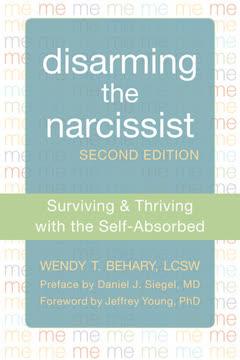
### Surviving and Thriving with the Self-Absorbed
**Author:** Wendy T. Behary
**Estimated Reading Time:** 45 minutes
**What You'll Learn:**
- Why narcissists behave the way they do and what drives their relentless need for admiration - How your own childhood patterns may be keeping you trapped in frustrating dynamics - A proven communication method that combines empathy with accountability - How to set boundaries that actually work and create leverage for change - When to stay, when to go, and how to protect yourself from dangerous narcissism
**Who This Book Is For:**
Anyone who has ever felt invisible, unheard, or emotionally exhausted in a relationship with a self-absorbed person. Whether the narcissist in your life is a partner, parent, colleague, friend, or family member, this book offers a path from frustration to clarity, from reactivity to intentional response, and from helplessness to genuine empowerment.
You know the feeling. You are sitting across from someone you care about, trying to explain something that matters to you. Perhaps you are sharing a frustration, expressing a need, or asking for understanding. And as you speak, you watch their eyes glaze over. You notice the subtle shift in their posture, the way their attention drifts to their phone, the slight sigh that tells you they are already bored. Within moments, the conversation has turned back to them. Their accomplishments. Their problems. Their needs. You leave the exchange feeling hollow, unseen, and somehow responsible for the failure of the conversation. You wonder if you explained yourself poorly. You wonder if you are being too sensitive. You wonder if this is just how relationships work. It is not. What you are experiencing may be the disorienting effect of interacting with a narcissist. Not the pop-psychology label we casually toss at anyone who takes too many selfies or enjoys a compliment. Real narcissism is something deeper, more pervasive, and more damaging to those caught in its orbit. It is a pattern of relating to the world that prioritizes self-image above all else, often at the expense of genuine connection. Wendy T. Behary has spent more than two decades sitting in therapy rooms with both narcissists and the people who love them, work with them, and struggle to survive them. She has seen the exhaustion in the eyes of partners who have spent years trying to be good enough, accommodating enough, understanding enough to finally earn the love and respect they deserve. She has heard the frustration of employees who watch a narcissistic colleague take credit for their work. She has witnessed the quiet devastation of children who grew up feeling invisible to a self-absorbed parent. And she has also seen something else. She has seen that change…
Continue reading in the MinuteRead app
Get the complete 30-minute summary of Disarming the Narcissist
Get the complete summary in the appNarcissistic behavior is a coping strategy developed to protect a fragile sense of self, not simply selfishness or arrog
Your own schemas, formed in childhood, shape how you respond to narcissistic behavior. Awareness of your schemas is the
Mindfulness creates space between stimulus and response, allowing you to choose intentional responses rather than automa
Empathic confrontation combines genuine understanding of the narcissist's experience with firm accountability for their
Empathy does not mean agreement. You can understand someone's experience without accepting their behavior.
Boundaries only work when backed by leverage. Identify what the narcissist values and connect your boundaries to those v
"Disarming the Narcissist" is a strong fit if you want practical ideas around health & fitness, psychology, self help, especially themes like narcissistic behavior is a coping strategy developed to protect a fragile sense of self, not simply selfishness or arrog; your own schemas, formed in childhood, shape how you respond to narcissistic behavior. awareness of your schemas is the. The MinuteRead summary distills these concepts into a focused read, whether you're deciding whether to buy the book or applying its lessons at work.
Wendy T. Behary LCSW is a licensed clinical social worker and psychotherapist specializing in treating narcissistic personality disorder and those affected by it. She is the founder and director of The Cognitive Therapy Center of New Jersey and The New Jersey Institute for Schema Therapy. Behary has over 25 years of experience in the field and is a founding fellow of the Academy of Cognitive Therapy. She is known for her expertise in schema therapy and has trained professionals worldwide. Behary…
View all summaries by Wendy T. BeharyContinue Reading
Access the complete 30-minute summary and thousands more nonfiction books in the MinuteRead app.

Continue reading the complete summary in the MinuteRead app.