MinuteRead
30 min
Book summary
Premium summary · Opens in the app · 30 min read
Most people experience the economy the way fish experience water. They swim through it every day without ever stopping to ask what it is, where it came from, or why it works the way it does. Prices appear on shelves. Paychecks arrive in bank accounts. News anchors announce that the economy is growing or shrinking. But the underlying system that produces all of this activity remains strangely invisible.
**Author:** Robert L. Heilbroner **Estimated Reading Time:** 45 minutes
**What You'll Learn:** How capitalism emerged as a revolutionary disruption to human history, why markets create order from chaos, what three great economists revealed about the system's strengths and weaknesses, and how modern economic forces shape your daily life.
**Who This Book Is For:** Anyone who wants to understand how the economic world actually works without getting lost in equations or jargon. If you have ever wondered why prices rise, what causes recessions, how governments influence the economy, or whether capitalism has a future, this book will give you a clear and lasting foundation.
Most people experience the economy the way fish experience water. They swim through it every day without ever stopping to ask what it is, where it came from, or why it works the way it does. Prices appear on shelves. Paychecks arrive in bank accounts. News anchors announce that the economy is growing or shrinking. But the underlying system that produces all of this activity remains strangely invisible. Robert L. Heilbroner believed this invisibility was a problem. Not because everyone needs to become an economist, but because the economy shapes nearly every aspect of modern life. It determines where people live, what work they do, how they raise their children, and what kind of future they can imagine. To be ignorant of economics is to be ignorant of one of the most powerful forces shaping human existence. The challenge is that economics has developed a reputation for being technical, abstract, and inaccessible. Textbooks overflow with graphs and equations. Specialists speak in a private language that excludes ordinary people. Yet Heilbroner understood that the core ideas of economics are not inherently difficult. They are simply ideas about how human beings organize themselves to survive and prosper. Once those ideas are explained clearly, they become not only understandable but genuinely fascinating. This book exists to provide that clarity. It explains what economics is, how economic systems have evolved, and how the modern market system actually functions. It does so without assuming any prior knowledge. It does so without drowning the reader in mathematics. And it does so without pretending that economics is a neutral science divorced from history, politics, and human values. The central problem Heilbroner addresses is the widespread confusion about what capitalism actually is. Many people assume that markets, private property, and the pursuit of profit are simply natural expressions of human behavior. They imagine that people have always bought and sold goods, always worked for wages, always organized production through businesses. This assumption is profoundly wrong. For most of human history, economic life was organized through tradition and command. People produced what their ancestors produced, using…
Continue reading in the MinuteRead app
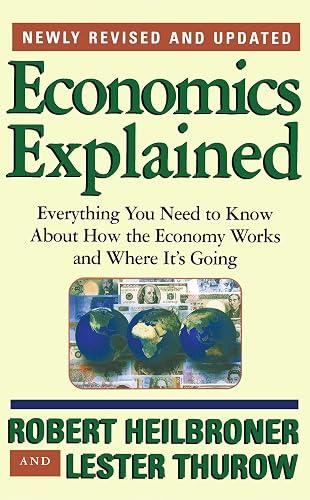
Get the complete 30-minute summary of Economics Explained
Get the complete summary in the appCapitalism is a historical system that emerged through disruption and displacement, not a natural expression of human na
The invisible hand coordinates economic activity through prices, which communicate information about scarcity and abunda
The division of labor dramatically increases productivity and is the engine of economic growth.
Marx identified real problems with capitalism: exploitation, inequality, crisis, and concentration of power.
Keynes showed that markets do not automatically self-correct and that government can manage demand to maintain full empl
GNP measures economic activity, not well-being, and should be used with caution.
"Economics Explained" is a strong fit if you want practical ideas around economics, finance, business, especially themes like capitalism is a historical system that emerged through disruption and displacement, not a natural expression of human na; the invisible hand coordinates economic activity through prices, which communicate information about scarcity and abunda. The MinuteRead summary distills these concepts into a focused read, whether you're deciding whether to buy the book or applying its lessons at work.
Motivated to help readers with thus we see that far from representing an eternal "human nature, Robert L. Heilbroner wrote “Economics Explained” to package those ideas for a fast, focused read. In “Economics Explained”, Robert L. Heilbroner focuses on thus we see that far from representing an eternal "human nature. Through “Economics Explained”, Robert L. Heilbroner distills the core ideas on economics into lessons readers can absorb in a single short sitting. Readers turn to this work when they…
View all summaries by Robert L. HeilbronerContinue Reading
Access the complete 30-minute summary and thousands more nonfiction books in the MinuteRead app.

Continue reading the complete summary in the MinuteRead app.