MinuteRead
30 min
There is a mystery hiding in plain sight. Look at an ant colony and you will see thousands of individual insects scurrying about, each one following what appears to be a remarkably limited set of behaviors. No single ant understands the colony's needs. No commander issues orders. No blueprint guides construction. Yet somehow, out of this chaos of individual actions, the colony accomplishes extraordinary things. It builds intricate tunnel systems. It finds the shortest routes to food sources. It
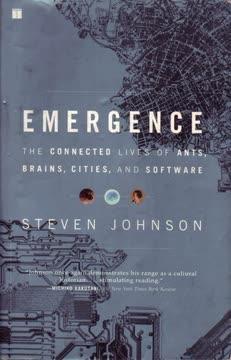
**The Connected Lives of Ants, Brains, Cities, and Software**
By Steven Johnson
**Estimated Reading Time:** 45 minutes
**What You'll Learn:**
- Why complex systems emerge from simple rules without any central planner - How ant colonies solve problems that baffle human engineers - Why cities behave like living organisms - What slime molds can teach us about intelligence - How feedback loops drive everything from neighborhoods to the internet - Why the future belongs to those who understand self-organization
**Who This Book Is For:**
Anyone who has ever wondered how order arises from chaos. If you are curious about why cities work, how brains think, what makes online communities thrive, or why the whole seems greater than the sum of its parts, this book will change how you see the world.
There is a mystery hiding in plain sight. Look at an ant colony and you will see thousands of individual insects scurrying about, each one following what appears to be a remarkably limited set of behaviors. No single ant understands the colony's needs. No commander issues orders. No blueprint guides construction. Yet somehow, out of this chaos of individual actions, the colony accomplishes extraordinary things. It builds intricate tunnel systems. It finds the shortest routes to food sources. It allocates workers to tasks with remarkable efficiency. It adapts to threats and opportunities with a sophistication that would impress any human organization. The same mystery appears in cities. Millions of people make independent decisions about where to live, where to work, where to shop, and where to gather. No central authority dictates that artists should cluster in one neighborhood or that financial firms should concentrate in another. No master planner decides which streets will become vibrant commercial corridors and which will remain quiet residential blocks. Yet patterns emerge. Neighborhoods develop distinct characters. Economic districts form. Cultural scenes flourish. The city organizes itself. And the mystery appears again in the human brain. Billions of neurons fire in complex patterns, each neuron responding to simple electrochemical signals from its neighbors. No single neuron knows what you are thinking. No region of the brain acts as a central executive reading the outputs of all the others. Yet consciousness emerges. You experience a unified sense of self, a continuous stream of thought, an awareness of your own existence. How does this happen? This book is about that mystery. It is about the phenomenon scientists call emergence: the process by which complex systems and patterns arise from relatively simple interactions among many individual agents. Emergence explains how order can appear without a designer, how intelligence can exist without a central brain, and how sophisticated behavior can emerge from remarkably simple rules. The idea of emergence…
Continue reading in the MinuteRead app
Get the complete 30-minute summary of Emergence
Get the complete summary in the appEmergence is the process by which complex patterns arise from simple interactions among many individual agents.
No central control is required for sophisticated collective behavior. Order can emerge from the bottom up.
Ant colonies demonstrate how simple rules produce intelligent behavior. Pheromone trails enable the colony to find optim
Cities are emergent systems. They grow and adapt through the collective actions of their inhabitants, not through top-do
Feedback loops are the engines of emergence. Positive feedback amplifies change. Negative feedback maintains stability.
The brain is a decentralized system. Consciousness emerges from the interactions of billions of simple neurons.
"Emergence" is a strong fit if you want practical ideas around science, technology, psychology, especially themes like emergence is the process by which complex patterns arise from simple interactions among many individual agents; no central control is required for sophisticated collective behavior. order can emerge from the bottom up. The MinuteRead summary distills these concepts into a focused read, whether you're deciding whether to buy the book or applying its lessons at work.
Steven Johnson is a prolific author known for his explorations of science, technology, and innovation. He has written twelve bestselling books, covering topics from urban planning to the history of ideas. Johnson's work often examines the interconnections between different fields and how they shape our world. In addition to writing, he hosts the podcast American Innovations and co-created the PBS/BBC series How We Got to Now. Johnson's ability to synthesize complex information and present it eng…
View all summaries by Steven JohnsonContinue Reading
Access the complete 30-minute summary and thousands more nonfiction books in the MinuteRead app.

Continue reading the complete summary in the MinuteRead app.