MinuteRead
30 min
Book summary
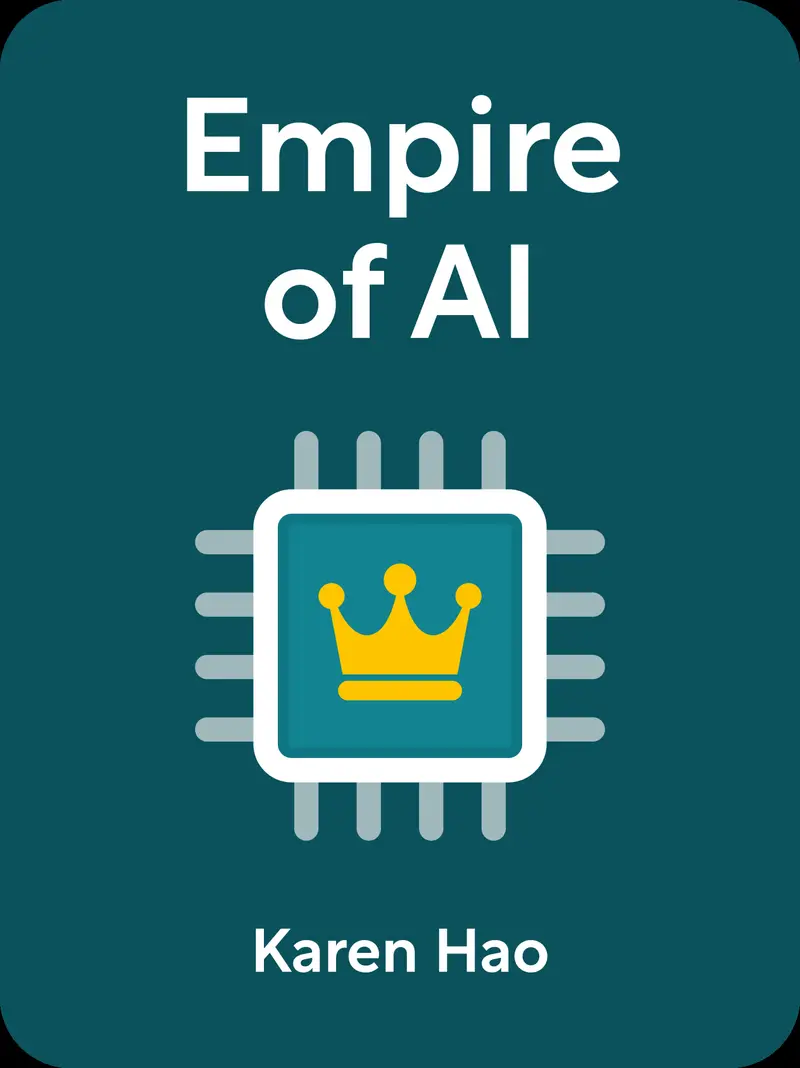
by Karen Hao
Premium summary · Opens in the app · 30 min read
The story of artificial intelligence is usually told as a story of progress. Brilliant engineers in Silicon Valley push the boundaries of what machines can do. Breakthroughs arrive at an accelerating pace. The future promises abundance, efficiency, and solutions to humanity's greatest challenges. This narrative is compelling, optimistic, and incomplete.
**Author:** Karen Hao
**Estimated Reading Time:** 45 minutes
**What You'll Learn:**
- How OpenAI transformed from an idealistic nonprofit into one of the most powerful companies in the world - The hidden human and environmental costs behind advanced AI systems - Why the race to build artificial general intelligence mirrors historical empire-building - The internal conflicts, governance failures, and power struggles that shaped the AI industry - Alternative visions for AI development that prioritize communities over corporations
**Who This Book Is For:**
This book is for anyone who wants to understand the real story behind the AI revolution. If you have used ChatGPT, read headlines about artificial intelligence, or wondered who actually controls this transformative technology, this book will give you the context and clarity that news coverage often misses. It is for readers who care about power, accountability, and the kind of future we are building.
The story of artificial intelligence is usually told as a story of progress. Brilliant engineers in Silicon Valley push the boundaries of what machines can do. Breakthroughs arrive at an accelerating pace. The future promises abundance, efficiency, and solutions to humanity's greatest challenges. This narrative is compelling, optimistic, and incomplete. Karen Hao's *Empire of AI* tells a different story. It is the story of how a small group of people, driven by a mix of idealism, ambition, and fear, built one of the most powerful institutions in modern history. It is the story of how promises about openness and safety gave way to secrecy and speed. It is the story of the workers who label toxic content for pennies an hour, the communities whose water and electricity are diverted to power data centers, and the artists whose work is scraped without consent to train models that will compete with them. The central figure in this story is OpenAI, the company behind ChatGPT. OpenAI began as a nonprofit with an extraordinary mission: to ensure that artificial general intelligence, or AGI, benefits all of humanity. Its founders pledged a billion dollars. They promised transparency, collaboration, and a willingness to step aside if another project got to AGI first. They explicitly positioned themselves as the opposite of Google, a giant corporation that would inevitably prioritize its own interests. Over the next four years, OpenAI became everything it said it would not be. This transformation did not happen by accident. It was driven by a specific technical bet, a belief that scaling up neural networks with ever more computing power was the surest path to AGI. That bet required money on a scale that no nonprofit could raise. It required partnerships with corporations like Microsoft. It required secrecy to stay ahead of competitors. It required a global…
Continue reading in the MinuteRead app
Get the complete 30-minute summary of Empire of AI
Get the complete summary in the appOpenAI began as an idealistic nonprofit and became a commercial powerhouse driven by the scaling hypothesis.
The scaling hypothesis is a self-fulfilling prophecy that demands enormous resources and crowds out alternatives.
AI depends on hidden workers who are exploited and traumatized for pennies an hour.
AI's environmental costs are enormous and fall disproportionately on vulnerable communities.
Safety concerns repeatedly lost to commercial pressures at OpenAI.
Sam Altman's leadership style created confusion, mistrust, and instability.
"Empire of AI" is a strong fit if you want practical ideas around artificial intelligence, technology, business, especially themes like openai began as an idealistic nonprofit and became a commercial powerhouse driven by the scaling hypothesis; the scaling hypothesis is a self-fulfilling prophecy that demands enormous resources and crowds out alternatives. The MinuteRead summary distills these concepts into a focused read, whether you're deciding whether to buy the book or applying its lessons at work.
Karen Hao is a technology journalist known for her coverage of artificial intelligence and its societal impacts. She has extensive experience reporting on OpenAI and other major tech companies, having covered the AI industry for several years. Hao's approach combines in-depth research with a critical lens on the power dynamics and ethical implications of AI development. Her work often explores themes of accountability, labor practices, and environmental consequences in the tech sector. Hao's wri…
View all summaries by Karen HaoContinue Reading
Access the complete 30-minute summary and thousands more nonfiction books in the MinuteRead app.

Continue reading the complete summary in the MinuteRead app.