MinuteRead
30 min
Book summary
Premium summary · Opens in the app · 30 min read
For most of human history, work has been the organizing principle of adult life. We structure our days around it, measure our worth by it, and build our communities through it. The question "What do you do?" is among the first we ask strangers. Work provides income, certainly, but it also provides identity, purpose, and a sense of belonging. The possibility that work might become scarce is not merely an economic concern. It is a question about what human life is for.
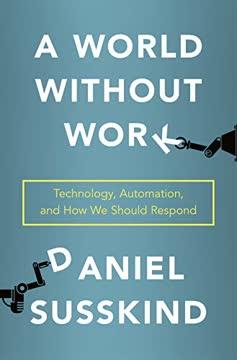
**Author:** Daniel Susskind **Estimated Reading Time:** 45 minutes
The forces reshaping the relationship between human beings and paid work, why past reassurances about automation may no longer hold, and what a world with less work might actually require from individuals, governments, and society.
Anyone who has wondered whether their job will exist in twenty years, policymakers trying to understand the economic shifts ahead, and readers curious about how technological change might transform not just the economy but the very meaning of human life.
For most of human history, work has been the organizing principle of adult life. We structure our days around it, measure our worth by it, and build our communities through it. The question "What do you do?" is among the first we ask strangers. Work provides income, certainly, but it also provides identity, purpose, and a sense of belonging. The possibility that work might become scarce is not merely an economic concern. It is a question about what human life is for. Daniel Susskind begins with a striking observation. Throughout the modern era, people have repeatedly feared that machines would make human labor obsolete. These fears have repeatedly proven unfounded. Each wave of technological change destroyed some jobs while creating others. The economy adapted. Workers adapted. The dire predictions never came true. But Susskind argues that the past may not be a reliable guide to the future. The reason lies in the nature of the technology now emerging. Earlier machines replaced human muscle. They took over physical tasks that required strength, repetition, and endurance. But they still needed human minds to direct them, human judgment to guide them, and human creativity to improve them. The new technologies are different. They are beginning to replace human intelligence itself. This is not a claim about conscious machines or artificial general intelligence. Susskind is careful to avoid the more speculative territory of science fiction. His argument is more grounded and, in some ways, more unsettling. Modern artificial intelligence does not need to think like a human being to outperform human beings at an expanding range of tasks. It simply needs to process vast amounts of data, recognize patterns, and make predictions. That capability, already demonstrated in domains from medical diagnosis to legal document review to creative writing, is sufficient to displace workers in ways that earlier technologies never could. The book is not a prediction of catastrophe. Susskind is not arguing that robots will take all the jobs overnight or that society will collapse into mass unemployment. His claim is more subtle and more important. He argues that the demand for human labor will gradually decline as machines become more capable. This decline will be uneven, affecting different industries and…
Continue reading in the MinuteRead app
Get the complete 30-minute summary of A World Without Work
Get the complete summary in the appTechnological unemployment is a real and growing force driven by the expanding capabilities of machines.
Work consists of tasks, and machines are gradually encroaching on the full range of human tasks.
Modern AI does not replicate human intelligence but can outperform humans at many tasks.
Past predictions of technological unemployment failed because new technologies created as many jobs as they destroyed, b
A job is vulnerable to automation if its most valuable tasks can be performed by machines.
Education is necessary but not sufficient for addressing technological unemployment.
"A World Without Work" is a strong fit if you want practical ideas around economics, business, artificial intelligence, especially themes like technological unemployment is a real and growing force driven by the expanding capabilities of machines; work consists of tasks, and machines are gradually encroaching on the full range of human tasks. The MinuteRead summary distills these concepts into a focused read, whether you're deciding whether to buy the book or applying its lessons at work.
Daniel Susskind is an economist and Fellow in Economics at Balliol College, Oxford. He specializes in the future of work and the impact of technology on employment. Susskind has written extensively on artificial intelligence, automation, and their economic implications. His academic background and research focus on the intersection of technology and labor markets. Susskind's work often explores policy solutions to address the challenges posed by technological unemployment. He is known for his ba…
View all summaries by Daniel SusskindContinue Reading
Access the complete 30-minute summary and thousands more nonfiction books in the MinuteRead app.

Continue reading the complete summary in the MinuteRead app.