MinuteRead
30 min
Book summary
by Sam Tatam
Premium summary · Opens in the app · 30 min read
Every organization wants to innovate. Every leader wants to be seen as visionary. Every entrepreneur dreams of creating the next iPhone, the next Tesla, the next thing that changes everything. The pressure to be revolutionary is everywhere. We celebrate the disruptors, the rule-breakers, the people who seem to conjure entirely new ideas from thin air.
**Author:** Sam Tatam
**Estimated Reading Time:** 45 minutes
**What You'll Learn:**
- Why revolutionary innovation is mostly a myth and why evolutionary thinking produces better results - How nature has already solved many of the problems you face - The hidden psychological principles that drive human behavior and how to apply them ethically - A systematic framework for finding proven solutions instead of gambling on untested ideas - Practical techniques for building trust, simplifying decisions, triggering action, and improving experiences
**Who This Book Is For:**
This book is for product designers, marketers, entrepreneurs, behavioral scientists, and anyone who has ever felt pressure to come up with a "big idea." If you have ever sat in a brainstorming session hoping for lightning to strike, this book will show you a more reliable path. It is for people who want to solve problems efficiently, ethically, and with a deep understanding of how humans actually think and behave.
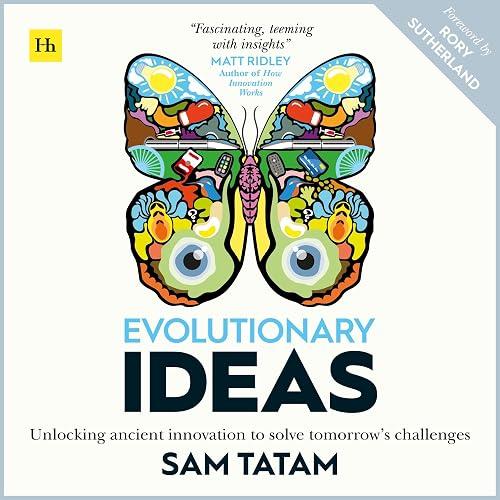
Every organization wants to innovate. Every leader wants to be seen as visionary. Every entrepreneur dreams of creating the next iPhone, the next Tesla, the next thing that changes everything. The pressure to be revolutionary is everywhere. We celebrate the disruptors, the rule-breakers, the people who seem to conjure entirely new ideas from thin air. But there is a problem with this obsession. Revolutionary thinking is expensive. It is risky. And it almost never works. Consider the numbers. Approximately 95 percent of new products fail. Around 70 percent of organizational transformations fall short of their goals. Only about 1 percent of patents represent truly novel innovations. The vast majority of successful ideas are not revolutionary at all. They are evolutionary. They are adaptations, refinements, and recombinations of things that already exist. Sam Tatam wrote *Evolutionary Ideas* to challenge a deeply held cultural assumption: that bigger problems require bigger, more original solutions. This assumption feels intuitive. When we see a massive challenge, our minds leap to the conclusion that only a massive, unprecedented intervention will solve it. But this intuition is wrong. In fact, it is a cognitive bias that leads us astray time and time again. The truth is that most of the problems we face have already been solved. Not just once, but many times, in many different contexts. The solutions exist in nature, in other industries, in other cultures, and in the deep structure of human psychology. The task is not to invent something from nothing. The task is to find the existing solution and adapt it to your specific challenge. This is what Tatam calls evolutionary thinking. It is a systematic approach to innovation that draws on the principles of biological evolution, the patterns of technological development, and the insights of behavioral…
Continue reading in the MinuteRead app
Get the complete 30-minute summary of Evolutionary Ideas
Get the complete summary in the appMost problems have already been solved. Your job is to find the existing solution and adapt it, not to invent something
Evolution is everywhere. The same principles of variation, selection, and retention operate in biology, technology, and
Nature is a vast library of proven solutions. Biomimicry can help you access billions of years of research and developme
TRIZ provides a systematic methodology for innovation. The 40 inventive principles and the contradiction matrix can help
The future of innovation is psychological, not technological. Behavioral science reveals the evolved mechanisms that dri
Trust can be built without changing the truth. Transparency, costly signaling, social proof, and vulnerable disclosure a
"Evolutionary Ideas" is a strong fit if you want practical ideas around psychology, business, science, especially themes like most problems have already been solved. your job is to find the existing solution and adapt it, not to invent something; evolution is everywhere. the same principles of variation, selection, and retention operate in biology, technology, and. The MinuteRead summary distills these concepts into a focused read, whether you're deciding whether to buy the book or applying its lessons at work.
Motivated to help readers with "Revolutionary thinking is an expensive and high-risk strategy, Sam Tatam wrote “Evolutionary Ideas” to package those ideas for a fast, focused read. In “Evolutionary Ideas”, Sam Tatam focuses on "Revolutionary thinking is an expensive and high-risk strategy. Through “Evolutionary Ideas”, Sam Tatam distills the core ideas on psychology into lessons readers can absorb in a single short sitting. Readers turn to this work when they want Sam Tatam's perspective on the …
Continue Reading
Access the complete 30-minute summary and thousands more nonfiction books in the MinuteRead app.

Continue reading the complete summary in the MinuteRead app.