MinuteRead
30 min
Book summary
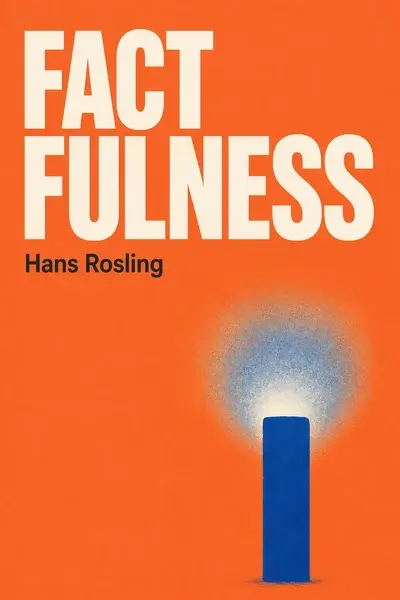
by Hans Rosling
Premium summary · Opens in the app · 5 min read
Factfulness explains how our worldview has been distorted with the rise of new media, which ten human instincts cause erroneous thinking, and how we can learn to separate fact from fiction when forming our opinions.
Factfulness explains how our worldview has been distorted with the rise of new media, which ten human instincts cause erroneous thinking, and how we can learn to separate fact from fiction when forming our opinions.
There are two kinds of people in the world: those who divide the world into two kinds of people, and those who don’t. What I hope to be a clever Quora answer of mine is also one of the first points Rosling makes. He calls it ‘the gap instinct.’ It’s our tendency to want to see things as black and white. The example he uses to illustrate it is the classic division of the world into East and West.
I, too, have grown up in a time where schools would teach Westerners that their countries are developed, while Asian ones are currently developing, trying to catch up. This instilled an us-vs-them mentality early on. But the truth is, whatever gap there was has almost completely disappeared over the past 20 years. How do we even define ‘developing’ and ‘developed?’
If we use child mortality, for example, only 13 countries could be considered ‘developing’ today. One thing’s for sure: dividing the world geographically to determine its economic, demographic, or psychological state is useless.
A second megamisconception, as Rosling calls these ideas that are rooted deeply, but incredibly wrong, is that of our impending doom due to exponential population growth. Books like The World Without Us elaborate on the idea that one day, nature will conceive devastating diseases and catastrophes to rid itself of the growing damage from humans. But while our growing numbers are sure a cause for concern, they might never hit apocalypse-worthy levels.
The UN’s projections for population growth see us hit 9.8 billion in 2050, and 11.2 billion in 2100. That’d be a double-up from 6.1 billion in 2000. But in 1900, there were only 1.6 billion humans, which means that in the last century, we grew fourfold, showing the growth rate is already declining. That’s because as countries get out of poverty, people tend to have fewer children. In countries like Germany, populations are even declining!
There are three biases that prevent our feelings from matching the numbers: the straight-line instinct, the fear instinct, and the size instinct. We misplace our primal fears, think trends continue in a straight line, and overestimate their size. That’s why population growth might feel like a huge threat, when actually, it’ll likely not be a big deal.
Democracy is one of the 21st century’s most popular ideas, because in it, Western countries have thrived. But right now, most of the fastest-growing countries aren’t democratic, indicating it’s not the only political system that works. And yet, we…
Continue reading in the MinuteRead app
Get the complete 5-minute summary of Factfulness
Get the complete summary in the appThe East vs. West mentality is outdated. We all share this planet.
Increasing population growth is blown out of proportion, because it’s likely to level off rather soon.
The only thing that allows you to see the world as it really is is to look at everything from multiple angles.
"Factfulness" is a strong fit if you want practical ideas around culture, economics, history, especially themes like the east vs. west mentality is outdated. we all share this planet; increasing population growth is blown out of proportion, because it’s likely to level off rather soon. The MinuteRead summary distills these concepts into a focused read, whether you're deciding whether to buy the book or applying its lessons at work.
Motivated to help readers with factfulness explains how our worldview has been distorted with the rise of new media, Hans Rosling wrote “Factfulness” to package those ideas for a fast, focused read. In “Factfulness”, Hans Rosling focuses on factfulness explains how our worldview has been distorted with the rise of new media. Through “Factfulness”, Hans Rosling distills the core ideas on history into lessons readers can absorb in a single short sitting. Readers turn to this work when they want Ha…
View all summaries by Hans RoslingContinue Reading
Access the complete 5-minute summary and thousands more nonfiction books in the MinuteRead app.

Continue reading the complete summary in the MinuteRead app.