MinuteRead
30 min
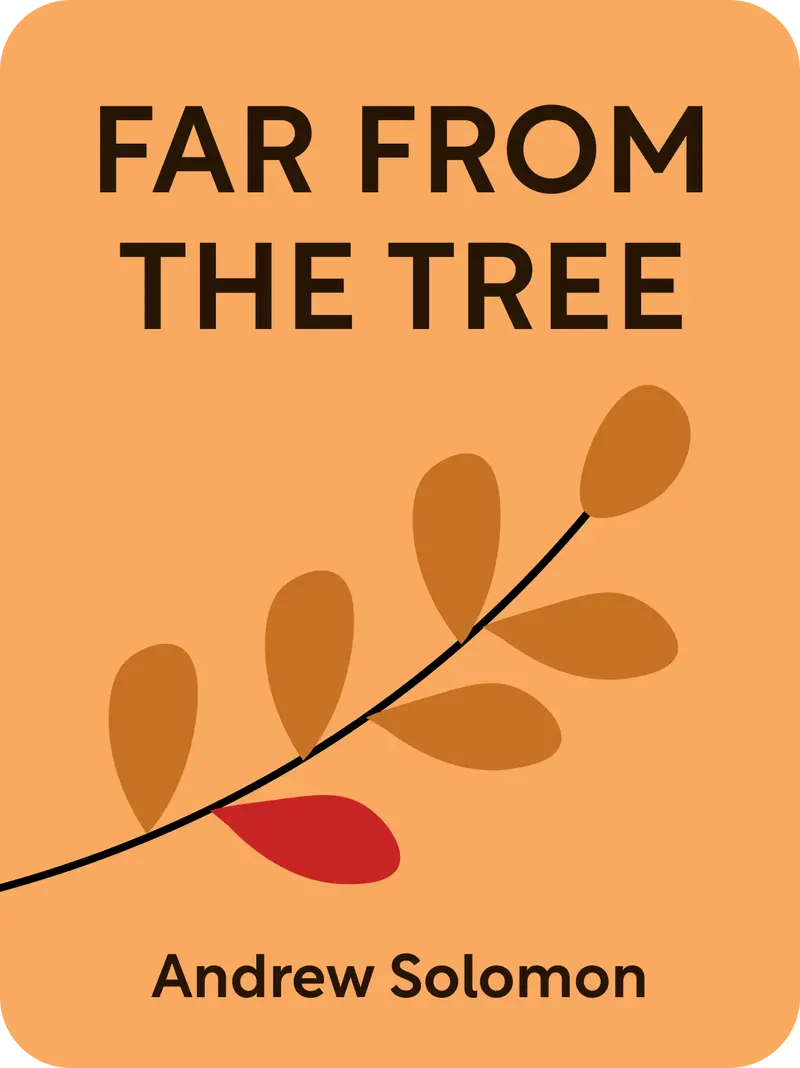
Book summary
Premium summary · Opens in the app · 30 min read
Every parent carries a vision of the child they will have. The vision is specific and deeply personal. It includes the color of the eyes, the shape of the smile, the sound of the laugh. It includes imagined conversations at the dinner table, shared interests, familiar mannerisms. It includes the quiet assumption that this child will be, in some essential way, a continuation of the self.
**Author:** Andrew Solomon **Estimated Reading Time:** 45 minutes
**What You'll Learn**
How families are transformed when children are profoundly different from their parents, why difference challenges our deepest assumptions about love and identity, and what the experience of exceptional families reveals about the nature of the human condition.
**Who This Book Is For**
Parents navigating the unexpected, anyone who has ever felt fundamentally different from their family, professionals working with diverse populations, and readers who want to understand how love expands beyond the boundaries we imagine for it.
Every parent carries a vision of the child they will have. The vision is specific and deeply personal. It includes the color of the eyes, the shape of the smile, the sound of the laugh. It includes imagined conversations at the dinner table, shared interests, familiar mannerisms. It includes the quiet assumption that this child will be, in some essential way, a continuation of the self. This vision is so deeply embedded that most parents never articulate it. It simply exists, shaping expectations and hopes before the child arrives. And then the child arrives, and the vision collides with reality. Sometimes the collision is gentle. The child has a different temperament than expected, different talents, different preferences. Parents adjust. They learn to love the child they have rather than the child they imagined. This is the ordinary work of parenthood. But sometimes the collision is profound. The child is deaf. The child has dwarfism. The child is autistic. The child is transgender. The child commits a terrible crime. The child is a prodigy whose abilities isolate them from peers and parents alike. The child has schizophrenia. The child was conceived through rape. In these cases, the gap between expectation and reality is not a gentle adjustment but a chasm. Parents must cross it, and the crossing changes everything they thought they knew about love, identity, and what it means to be a family. Andrew Solomon spent more than a decade interviewing hundreds of families facing exactly this kind of chasm. He spoke with parents of deaf children and parents of children with Down syndrome. He spoke with families affected by autism, schizophrenia, and severe disability. He spoke with parents of prodigies and parents of children who committed murder. He spoke with mothers who raised children conceived through rape. He spoke with parents who discovered their children were transgender. What he found was not what he expected. He expected to find tragedy. He found some tragedy, certainly. But he also found something else: families who described their experiences not as catastrophes but as transformations. Parents who said they would not change their children even if they could. Parents who discovered capacities for love,…
Continue reading in the MinuteRead app
Get the complete 30-minute summary of Far From The Tree
Get the complete summary in the appThere is no such thing as reproduction. Children are not copies of their parents but entirely new beings.
Horizontal identities are traits children possess that parents do not. They must be learned, not inherited.
Difference is not a problem to be solved but a reality to be embraced.
The social model of disability locates the problem in society, not in the individual.
Love is not the absence of difficulty but the commitment to work through difficulty.
Acceptance and intervention are not opposites. Both are necessary for supporting children with differences.
"Far From The Tree" is a strong fit if you want practical ideas around psychology, parenting, science, especially themes like there is no such thing as reproduction. children are not copies of their parents but entirely new beings; horizontal identities are traits children possess that parents do not. they must be learned, not inherited. The MinuteRead summary distills these concepts into a focused read, whether you're deciding whether to buy the book or applying its lessons at work.
Andrew Solomon is an acclaimed writer and lecturer focusing on politics, culture, and mental health. He has written for prestigious publications like The New York Times and The New Yorker, covering diverse topics from depression to international politics. Solomon's work has earned him recognition in the field of mental health, including the Humanitarian Award from the Society of Biological Psychiatry. He holds a lecturer position at Cornell Medical School and divides his time between New York an…
View all summaries by Andrew SolomonContinue Reading
Access the complete 30-minute summary and thousands more nonfiction books in the MinuteRead app.

Continue reading the complete summary in the MinuteRead app.