MinuteRead
30 min
Book summary
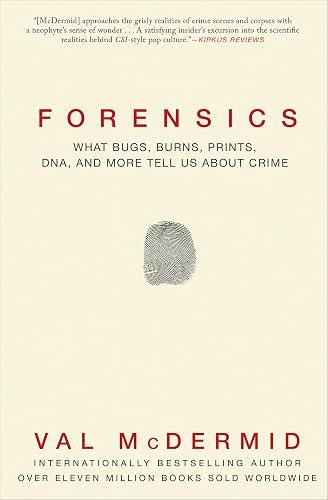
by Val McDermid
Premium summary · Opens in the app · 5 min read
Forensics: The Anatomy Of Crime gives you an inside looks at all the different fields of criminal forensics and their history, showing you how the investigation and evidence-collection of crimes has changed dramatically within the last 200 years, helping us find the truth behind more and more crimes.
Forensics: The Anatomy Of Crime gives you an inside looks at all the different fields of criminal forensics and their history, showing you how the investigation and evidence-collection of crimes has changed dramatically within the last 200 years, helping us find the truth behind more and more crimes.
Let’s say you light a firecracker on New Year’s Eve, a big one that explodes into lots of pieces with a loud bang. The next day, you have to clean up, and because just collecting dirt and throwing it away isn’t much fun, you decide to try and piece it back together for fun.
Note: Don’t ever really try to do that, when I wrote it out I realized it’s a horrible idea, because of all the explosives. This is just a thought experiment!
Where would you start? Probably at the place where it exploded, right, because there, the most pieces lie. But that’d be a mistake no forensic scientist would ever make. If you start with the source, you’ll automatically make conclusions about the whole picture, which might lead you to miss crucial details.
For example, based on the three big firecracker parts at the sight of the explosion, you might think there can’t be more than 15 in total, and will stop looking for more small pieces once you have that many. But if you work from the outside in, just collecting everything you can find, and then slowly bringing everything back to the source, you’ll get a much more complete picture of what’s going on.
Looking at everything that’s on the outside and then slowly working towards the inside is a key principle of forensics. Fire scene investigators, forensic pathologists and bloodstain analysts all do their work this way.
Alexander Fleming leaving his Petri dish unprotected for two weeks led to the invention of penicillin. Archimedes had his Eureka! moment in the bathtub and found out how to measure the volume of objects. Many of science’s greatest discoveries were originally made by chance, and the now-standard forensic tool of fingerprint identification is no exception. In the 1870s, Scottish doctor and missionary Henry Faulds set up an English medical mission in Japan, where, on a trip to an archeological site, he discovered you could see some of the marks ancient pottery makers had left on their work in dug up clay fragments. If you dusted them with powder, they’d become a lot clearer to distinguish. After looking at his own fingerprints and some of his friends, he hypothesized they might be unique to each human being, a theory that helped him prove the innocence of one of his staff members when his hospital was broken into. Convinced that his system…
Continue reading in the MinuteRead app
Get the complete 5-minute summary of Forensics: The Anatomy Of Crime
Get the complete summary in the appWorking from the outside to the inside is a guiding principle of forensics.
The fingerprint system came from Japanese pottery makers.
Thanks to the power of computers, the rate of crimes we solve will keep going up.
"Forensics: The Anatomy Of Crime" is a strong fit if you want practical ideas around culture, history, science, especially themes like working from the outside to the inside is a guiding principle of forensics; the fingerprint system came from japanese pottery makers. The MinuteRead summary distills these concepts into a focused read, whether you're deciding whether to buy the book or applying its lessons at work.
Val McDermid is a number one bestseller whose novels have been translated into more than forty languages, and have sold over eighteen million copies. She has won many awards internationally, including the CWA Gold Dagger for best crime novel of the year and the LA Times Book of the Year Award. She was inducted into the ITV3 Crime Thriller Awards Hall of Fame in 2009, was the recipient of the CWA Cartier Diamond Dagger in 2010 and received the Lambda Literary Foundation Pioneer Award in 2011. In …
View all summaries by Val McDermidContinue Reading
Access the complete 5-minute summary and thousands more nonfiction books in the MinuteRead app.

Continue reading the complete summary in the MinuteRead app.