MinuteRead
30 min
Every profession carries a promise. Journalism promises to tell the truth. Medicine promises to heal. Law promises to pursue justice. Science promises to expand human knowledge. Education promises to develop minds. These promises are not written into contracts or job descriptions. They are embedded in the very idea of what it means to be a professional.
**Author:** Howard Gardner
**Estimated Reading Time:** 42 minutes
**What You'll Learn:**
- Why technical excellence alone is no longer enough in professional life - How two professions, genetics and journalism, reveal what happens when work aligns with or drifts from its core mission - What market forces and technology are doing to professional standards - How individuals and institutions can protect the integrity of their work - A practical framework for doing work that is both excellent and ethical
**Who This Book Is For:**
Professionals who sense that something is shifting beneath their feet. Journalists watching their industry transform. Scientists navigating ethical frontiers. Doctors, lawyers, teachers, and business leaders who want their work to matter beyond the bottom line. Anyone who has ever wondered whether doing good work is still possible in a world that seems to reward speed, spectacle, and self-interest.
Every profession carries a promise. Journalism promises to tell the truth. Medicine promises to heal. Law promises to pursue justice. Science promises to expand human knowledge. Education promises to develop minds. These promises are not written into contracts or job descriptions. They are embedded in the very idea of what it means to be a professional. But promises can be broken. And in the late twentieth and early twenty-first centuries, something began to happen across the professional landscape. The promises started to fray. Howard Gardner, a cognitive psychologist at Harvard University, spent years studying how people think, learn, and create. But in the mid-1990s, he found himself drawn to a different set of questions. What happens when talented people, trained to high standards, find themselves working in conditions that make it harder and harder to live up to those standards? What happens when the institutions that once protected professional values begin to prioritize other things? What happens to the promise then? Gardner and his colleagues at the GoodWork Project set out to investigate. They interviewed over a thousand professionals across multiple fields. They talked to journalists and geneticists, actors and doctors, lawyers and teachers. They asked people what they did, why they did it, what pressures they faced, and how they navigated the tensions between what they believed in and what their work demanded. What they found was both troubling and hopeful. The troubling part is familiar to anyone who has watched the news media transform over the past few decades. Journalism, once understood as a public trust, has become increasingly driven by market logic. News organizations chase ratings, clicks, and advertising revenue. Investigative reporting has declined. The line between news and entertainment has blurred. Public trust in journalism has fallen to historic lows. The promise of journalism, to inform citizens and hold power accountable, is under siege.…
Continue reading in the MinuteRead app
Get the complete 30-minute summary of Good Work
Get the complete summary in the appGood work combines excellence and ethics. Neither is enough alone.
Good work depends on alignment between the individual, the domain, the field, and society.
Alignment is not permanent. It must be actively maintained.
Technology and market pressures are the two primary forces of misalignment.
Genetics and journalism represent contrasting states of alignment. The contrast reveals what supports good work.
Moral identity is the inner compass that guides professional choices. It can be developed through reflection and practic
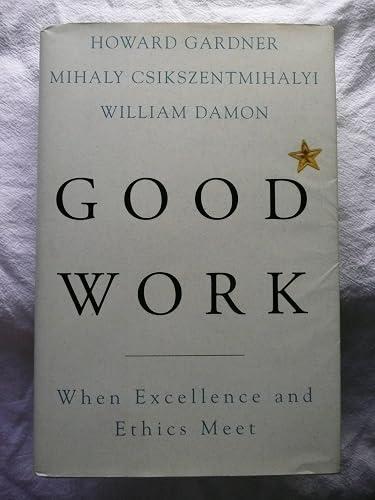
"Good Work" is a strong fit if you want practical ideas around psychology, business, philosophy, especially themes like good work combines excellence and ethics. neither is enough alone; good work depends on alignment between the individual, the domain, the field, and society. The MinuteRead summary distills these concepts into a focused read, whether you're deciding whether to buy the book or applying its lessons at work.
Motivated to help readers with both excellent in quality and socially responsible, Howard Gardner wrote “Good Work” to package those ideas for a fast, focused read. In “Good Work”, Howard Gardner focuses on both excellent in quality and socially responsible. Through “Good Work”, Howard Gardner distills the core ideas on psychology into lessons readers can absorb in a single short sitting. Readers turn to this work when they want Howard Gardner's perspective on the subject without working through…
View all summaries by Howard GardnerContinue Reading
Access the complete 30-minute summary and thousands more nonfiction books in the MinuteRead app.

Continue reading the complete summary in the MinuteRead app.