MinuteRead
30 min
Book summary
Premium summary · Opens in the app · 5 min read
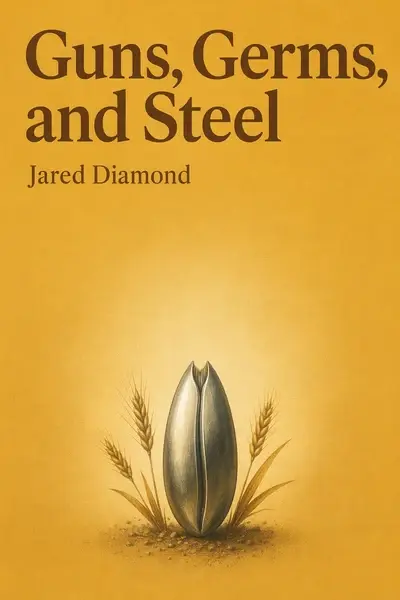
Guns, Germs, and Steel is a multidisciplinary study that employs anthropological, biological, evolutionary, and socio-economic analyses to chart the fates of different peoples throughout human history and understand why some groups succeeded to develop and advance, while others haven’t.
Guns, Germs, and Steel is a multidisciplinary study that employs anthropological, biological, evolutionary, and socio-economic analyses to chart the fates of different peoples throughout human history and understand why some groups succeeded to develop and advance, while others haven’t.
The reason behind some nations’ advanced developments can be traced back to a common, low-interest idea – food. More precisely, it seems that agriculture contributed to the first flourishing societies. In Mesopotamia, archeologists found the first traces of specialized agriculture, followed by China and Mesoamerica.
The first human beings emerged in Africa, but they soon left to spread in search of food and a better life. The first civilizations to differentiate themselves from others used agriculture to develop a better world, around 11,000 years ago. In time, people discovered cooking plants, growing seeds, use animals as sources of food and labor.
All these discoveries helped us reach the state of humanity we know today. Better food meant better health, improved cognitive functions, and more developed society. However, living alongside animals also meant more germs and diseases.
In time, people from those regions grew immune to diseases, while in different parts of the world others were still struggling to grow food and fight minor sicknesses. Their strong immunity was passed down to their children, which fortified our genes in time. Therefore, there is a strong connection between agriculture and our evolution.
As people started to grow food for more than just themselves and agriculture became the major profession of individuals, there had to be a record-keeping system in place. This is largely how language formed, as communities started collaborating to grow food.
We know that agriculture started in Mesopotamia, and so that’s where the first forms of language emerged. As people were increasingly stronger and more advanced than in other parts of the world, their communication was also fortified by a more active mind and body.
Slowly, they started talking about more than just crops, which is how culture began to take different forms through language.
One interesting fact about our world is that, throughout history, information was diffused from east to west, and rarely the other way around.
This way, agricultural societies helped spread valuable ideas throughout the world while also strengthening their perpetrator status. It is a known fact that agricultural communities were more advanced than simple hunter-gathering societies, which is another reason for their complex development.
Growing food also allowed people to store large quantities for later, which meant more free time for them to explore other areas of life. Increasingly, culture grew stronger and larger in these places of the world, paving the way for future states and complex communities to form.
Continue reading in the MinuteRead app
Get the complete 5-minute summary of Guns, Germs, and Steel
Get the complete summary in the appMesopotamia was the first region in the world where people started to practice agriculture.
Agriculture gave way for culture and languages to form.
People evolved differently because of the environmental factors around them, not due to biological differences.
"Guns, Germs, and Steel" is a strong fit if you want practical ideas around culture, environment, history, especially themes like mesopotamia was the first region in the world where people started to practice agriculture; agriculture gave way for culture and languages to form. The MinuteRead summary distills these concepts into a focused read, whether you're deciding whether to buy the book or applying its lessons at work.
Motivated to help readers with multidisciplinary study that employs anthropological, Jared Diamond wrote “Guns, Germs, and Steel” to package those ideas for a fast, focused read. In “Guns, Germs, and Steel”, Jared Diamond focuses on multidisciplinary study that employs anthropological. Through “Guns, Germs, and Steel”, Jared Diamond distills the core ideas on environment into lessons readers can absorb in a single short sitting. Readers turn to this work when they want Jared Diamond's perspectiv…
View all summaries by Jared DiamondContinue Reading
Access the complete 5-minute summary and thousands more nonfiction books in the MinuteRead app.

Continue reading the complete summary in the MinuteRead app.