MinuteRead
30 min
Book summary
by Guy Claxton
Premium summary · Opens in the app · 30 min read
There is a story that runs through Western culture like a thread through fabric. It is a story about thinking, about what counts as intelligence, about what it means to know something. And according to this story, the mind works best when it works fast, deliberately, and consciously. The story says that real thinking involves weighing options, constructing arguments, demanding evidence, and arriving at clear conclusions. Anything less than this is not thinking at all. It is daydreaming, woolgath
By Guy Claxton
**Estimated Reading Time:** 45 minutes
**What You'll Learn:**
- Why your fastest thinking is often your worst thinking - How the slow, quiet intelligence of the unconscious mind works - Why patience produces better answers than cleverness for life's hardest problems - How to access the creative, intuitive capacities you already possess - Why modern culture has trained you to think in exactly the wrong way
**Who This Book Is For:**
Anyone who has ever felt stuck on a problem, rushed into a decision they later regretted, or suspected that their best thinking happens when they stop trying so hard. This book is for people who want to recover a deeper, wiser way of knowing that modern life has nearly trained out of them.
There is a story that runs through Western culture like a thread through fabric. It is a story about thinking, about what counts as intelligence, about what it means to know something. And according to this story, the mind works best when it works fast, deliberately, and consciously. The story says that real thinking involves weighing options, constructing arguments, demanding evidence, and arriving at clear conclusions. Anything less than this is not thinking at all. It is daydreaming, woolgathering, wasting time. Guy Claxton believes this story is wrong. Not entirely wrong, but dangerously incomplete. And he wrote this book to explain why. The problem is not that deliberate, conscious reasoning is useless. It is enormously useful. It helps us calculate, plan, analyze, and solve well-defined problems. The problem is that we have come to treat this one mode of thinking as the only legitimate one. We have built our schools, our workplaces, and our institutions around the assumption that faster, more explicit, more analytical thinking is always better. And in doing so, we have starved a different kind of intelligence, one that works slowly, quietly, and largely beneath the surface of awareness. Claxton calls this other intelligence the undermind. It is the part of you that solves problems while you sleep, that recognizes patterns you cannot articulate, that generates hunches and intuitions and creative breakthroughs. It is the part of you that knows more than you can say. And it is under threat. The modern world runs on what Claxton calls d-mode: deliberate, conscious, purposeful reasoning. The "d" stands for deliberation, but it might as well stand for default, because this is the mode we default to in nearly every situation. When faced with a problem, we immediately try to figure it out. We analyze, we list pros and cons, we demand clarity. We treat every challenge as if it were a technical problem with a technical solution. But many of life's most…
Continue reading in the MinuteRead app
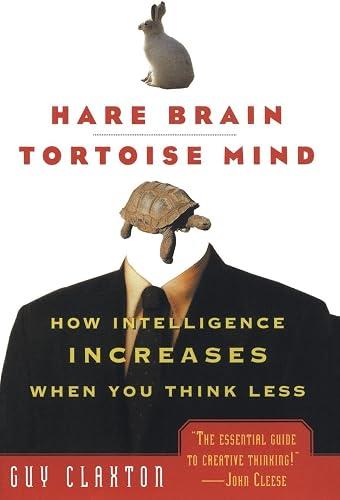
Get the complete 30-minute summary of Hare Brain, Tortoise Mind
Get the complete summary in the appThe mind has multiple speeds, and the fastest is not always the best.
Match your thinking mode to the type of challenge: problems need analysis, predicaments need patience.
The undermind is an intelligent unconscious that detects patterns, generates intuitions, and solves problems.
You know more than you can say; much of your knowledge is implicit.
Overthinking disrupts skilled performance; get out of your own way.
Intuition is educated guesswork; treat it as a hypothesis, not a verdict.
"Hare Brain, Tortoise Mind" is a strong fit if you want practical ideas around psychology, science, self help, especially themes like the mind has multiple speeds, and the fastest is not always the best; match your thinking mode to the type of challenge: problems need analysis, predicaments need patience. The MinuteRead summary distills these concepts into a focused read, whether you're deciding whether to buy the book or applying its lessons at work.
Motivated to turn hard-won expertise into something readers can use every day, Guy Claxton wrote “Hare Brain, Tortoise Mind” to distill the ideas behind the work into clear, actionable lessons. Through “Hare Brain, Tortoise Mind”, Guy Claxton distills the core ideas on psychology into lessons readers can absorb in a single short sitting. Readers turn to this work when they want Guy Claxton's perspective on the subject without working through the entire original volume. The book is structured so …
View all summaries by Guy ClaxtonContinue Reading
Access the complete 30-minute summary and thousands more nonfiction books in the MinuteRead app.

Continue reading the complete summary in the MinuteRead app.