MinuteRead
30 min
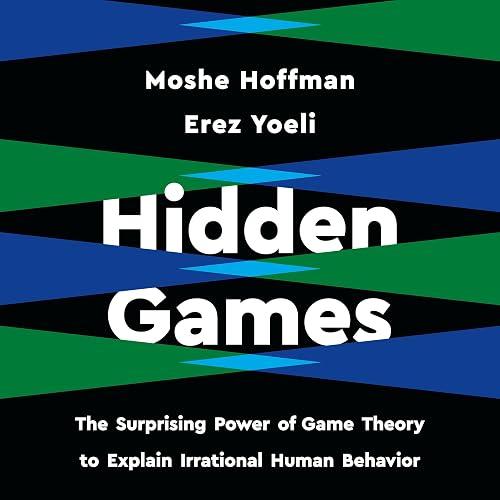
Book summary
by Erez Yoeli
Premium summary · Opens in the app · 30 min read
Imagine walking through a wealthy neighborhood and noticing the perfectly manicured lawns. Each one consumes thousands of gallons of water. Each one requires constant attention. Each one produces nothing edible and serves no practical purpose that a simpler ground covering would not also serve. Now imagine asking the homeowner why they maintain it. They will tell you it looks nice. They might mention property values. They will almost certainly not tell you the real reason.
**Authors:** Erez Yoeli and Moshe Hoffman
**Estimated Reading Time:** 45 minutes
**What You'll Learn:**
- Why people buy luxury goods they do not need - How cooperation emerges without anyone enforcing it - Why we fool ourselves before we fool others - What invisible mathematics governs our sense of fairness - How to see the strategic logic behind everyday behavior
**Who This Book Is For:**
Anyone who has ever wondered why people act against their own stated interests, why societies punish some actions and ignore others, or how human behavior can be both deeply irrational and perfectly logical at the same time. This book is for readers who want a new lens for understanding the social world.
Imagine walking through a wealthy neighborhood and noticing the perfectly manicured lawns. Each one consumes thousands of gallons of water. Each one requires constant attention. Each one produces nothing edible and serves no practical purpose that a simpler ground covering would not also serve. Now imagine asking the homeowner why they maintain it. They will tell you it looks nice. They might mention property values. They will almost certainly not tell you the real reason. The real reason is that the lawn is a message. It says: I have enough resources to waste water, time, and money on something purely ornamental. I am so secure in my position that I can afford to be impractical. This message is not conscious. The homeowner genuinely believes they simply like a nice lawn. But the behavior persists across cultures and centuries because it does something useful. It signals something true. This is a hidden game. Most of human behavior, argue Erez Yoeli and Moshe Hoffman, operates according to rules we never consciously learned. We play games we do not know we are playing. We follow strategies we cannot articulate. We respond to incentives we would deny having. And yet these hidden games shape everything from our taste in art to our sense of right and wrong. The authors are not moralists. They are not here to condemn or celebrate. They are scientists in the tradition of evolutionary biology and behavioral economics, and their tool is game theory. Game theory is a branch of mathematics that studies how people, firms, countries, and even genes behave when outcomes depend not just on what one actor does, but on what others do as well. It is the mathematics of strategic interaction. For decades, game theory lived mostly in economics departments and military planning offices. It produced Nobel Prizes and dense academic papers. But Yoeli and Hoffman argue that game theory belongs in everyday life. It explains why we punish people who have done us no direct harm. It explains…
Continue reading in the MinuteRead app
Get the complete 30-minute summary of Hidden Games
Get the complete summary in the app**Hidden games shape behavior.** People respond to incentives they cannot articulate. Look for the game underneath the b
**Waste is a signal.** Costly displays communicate qualities that are hard to fake. The cost is what makes the signal re
**Cooperation requires repetition.** The shadow of the future creates incentives for cooperation. Trust is built on repe
**Emotions are strategies.** Trust, anger, guilt, and love are evolutionary implementations of strategic behavior.
**We bias our beliefs to persuade others.** Motivated reasoning is an internalized persuasion strategy. We believe what
**Coordination requires common knowledge.** It is not enough to know something. You must know that others know it too.
"Hidden Games" is a strong fit if you want practical ideas around economics, psychology, science, especially themes like **hidden games shape behavior.** people respond to incentives they cannot articulate. look for the game underneath the b; **waste is a signal.** costly displays communicate qualities that are hard to fake. the cost is what makes the signal re. The MinuteRead summary distills these concepts into a focused read, whether you're deciding whether to buy the book or applying its lessons at work.
Motivated to help readers with game theory is a mathematical tool kit designed to help us figure out how people, Erez Yoeli wrote “Hidden Games” to package those ideas for a fast, focused read. In “Hidden Games”, Erez Yoeli focuses on game theory is a mathematical tool kit designed to help us figure out how people. Through “Hidden Games”, Erez Yoeli distills the core ideas on economics into lessons readers can absorb in a single short sitting. Readers turn to this work when they want Erez Yoeli'…
Continue Reading
Access the complete 30-minute summary and thousands more nonfiction books in the MinuteRead app.

Continue reading the complete summary in the MinuteRead app.