MinuteRead
30 min
Book summary
Premium summary · Opens in the app · 30 min read
Every society that has ever achieved technological greatness has eventually faced the same question: what happens when the easy gains are exhausted? What happens when you have picked all the low-hanging fruit, adopted all the available technologies, and caught up to the frontier of human knowledge? At that moment, the rules of the game change entirely.
**Author:** Carl Benedikt Frey
**Estimated Reading Time:** 45 minutes
**What You'll Learn:**
- Why some societies leap ahead technologically while others stagnate - The hidden tension between centralized control and decentralized innovation - How China's early advantages became its greatest liabilities - Why America's "weak" government became its innovation superpower - The dictator's dilemma: why authoritarian regimes struggle at the technological frontier - What the rise of corporate power means for future innovation - How AI could either accelerate progress or entrench control
**Who This Book Is For:**
This book is for anyone who wants to understand why technological progress happens, why it sometimes stops, and what determines whether societies continue advancing or fall behind. It is for entrepreneurs, policymakers, investors, and curious readers who sense that something fundamental shapes the pace of innovation but cannot quite articulate what it is. If you have ever wondered why Silicon Valley emerged in California rather than Tokyo or Beijing, or why the Industrial Revolution began in Britain rather than China, this book provides the answer.
Every society that has ever achieved technological greatness has eventually faced the same question: what happens when the easy gains are exhausted? What happens when you have picked all the low-hanging fruit, adopted all the available technologies, and caught up to the frontier of human knowledge? At that moment, the rules of the game change entirely. Carl Benedikt Frey's central insight is both simple and profound. There are two fundamentally different ways to make economic progress. The first is exploitation: taking existing technologies and scaling them up, refining them, and spreading them across an economy. The second is exploration: venturing into the unknown, conducting thousands of small experiments, and discovering genuinely new technological trajectories. These two modes of progress require fundamentally different institutional arrangements. Exploitation thrives under centralized, bureaucratic management. When the path forward is clear, when the technologies already exist and simply need to be deployed, a strong state can coordinate resources, override obstacles, and achieve remarkable results. Exploration, by contrast, requires decentralization. It requires many independent actors pursuing different ideas, making mistakes, and occasionally stumbling upon breakthroughs that no central planner could have predicted. This distinction explains one of the great puzzles of economic history. Why did China, which was the most technologically advanced civilization on Earth for over a millennium, fail to produce the Industrial Revolution? Why did Europe, which was comparatively backward for centuries, suddenly leap ahead? And why did the United States, with its famously weak federal government, become the engine of frontier innovation in the nineteenth and twentieth centuries? The answer lies in the fit between institutional structures and the demands of the technological moment. China's centralized bureaucracy was extraordinarily effective…
Continue reading in the MinuteRead app
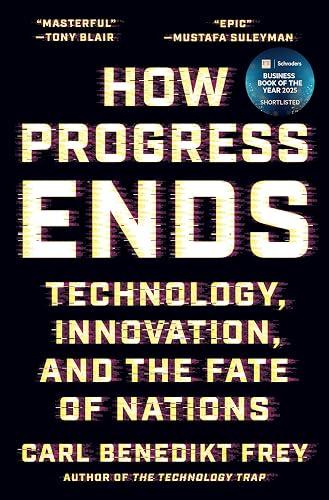
Get the complete 30-minute summary of How Progress Ends
Get the complete summary in the appProgress has two modes: exploitation (scaling existing technologies) and exploration (discovering new ones).
Centralized systems excel at exploitation; decentralized systems excel at exploration.
The optimal institutional arrangement depends on a society's distance from the technological frontier.
The conflict between incumbents and challengers is permanent and can never be fully resolved except by stagnation.
China's centralized bureaucracy enabled early technological leadership but eventually stifled innovation.
Europe's political fragmentation created a "market for ideas" that fostered the Scientific Enlightenment and Industrial
"How Progress Ends" is a strong fit if you want practical ideas around economics, history, politics, especially themes like progress has two modes: exploitation (scaling existing technologies) and exploration (discovering new ones); centralized systems excel at exploitation; decentralized systems excel at exploration. The MinuteRead summary distills these concepts into a focused read, whether you're deciding whether to buy the book or applying its lessons at work.
Motivated to help readers with stated simply, Carl Benedikt Frey wrote “How Progress Ends” to package those ideas for a fast, focused read. In “How Progress Ends”, Carl Benedikt Frey focuses on stated simply. Through “How Progress Ends”, Carl Benedikt Frey distills the core ideas on economics into lessons readers can absorb in a single short sitting. Readers turn to this work when they want Carl Benedikt Frey's perspective on the subject without working through the entire original volume. Carl B…
View all summaries by Carl Benedikt FreyContinue Reading
Access the complete 30-minute summary and thousands more nonfiction books in the MinuteRead app.

Continue reading the complete summary in the MinuteRead app.