MinuteRead
30 min
Book summary
by Gerard I. Nierenberg
Premium summary · Opens in the app · 30 min read
Every conversation is two conversations. The first is spoken, composed of words, sentences, and arguments. The second is silent, composed of gestures, postures, facial expressions, and the invisible signals that flow between people. Most of us pay attention only to the first conversation. We listen to words, craft responses, and miss the richer, more honest dialogue happening right in front of us.
**Author:** Gerard I. Nierenberg
**Estimated Reading Time:** 45 minutes
**What You'll Learn:**
- How to decode the silent language of gestures, postures, and expressions - Why gesture clusters matter more than isolated movements - How to recognize openness, defensiveness, evaluation, and suspicion - How to spot readiness, frustration, confidence, and nervousness - How to apply nonverbal literacy in negotiations, relationships, and daily life
**Who This Book Is For:**
Anyone who wants to understand what people are really saying beneath their words. Whether you are a negotiator, manager, salesperson, teacher, parent, or simply someone who wants better relationships, this book will change how you see every interaction.
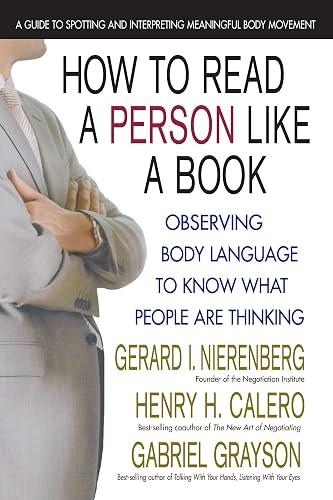
Every conversation is two conversations. The first is spoken, composed of words, sentences, and arguments. The second is silent, composed of gestures, postures, facial expressions, and the invisible signals that flow between people. Most of us pay attention only to the first conversation. We listen to words, craft responses, and miss the richer, more honest dialogue happening right in front of us. Gerard I. Nierenberg wrote *How to Read a Person Like a Book* to address a simple but profound problem: human beings communicate far more through their bodies than through their speech, yet most of us remain functionally illiterate in this silent language. We walk through negotiations, meetings, dates, and family dinners seeing only the surface of what others are expressing. We miss the crossed arms that signal resistance, the subtle lean forward that indicates readiness, the hand-to-chin gesture that reveals evaluation. And because we miss these signals, we fail to respond appropriately. We push when we should pause. We close when we should listen. We speak when we should observe. The stakes are higher than most people realize. Consider the mathematics of listening. The human brain can process between 650 and 700 words per minute. The average person speaks at a rate of 150 to 160 words per minute. This means that during any conversation, roughly three-quarters of our mental capacity sits idle, waiting to be used. What do we do with that spare capacity? Most people use it to rehearse their next point, to daydream, or to mentally argue with the speaker. Nierenberg suggests a better use: observe. While the words flow past, the body is speaking. The hands, the eyes, the posture, the distance between two people, all of these are broadcasting information. The skilled observer uses that spare mental capacity to read the silent conversation. This book emerged from Nierenberg's work as a negotiation consultant and trainer. Through the Negotiation Institute, he worked with executives, lawyers, salespeople, and government officials. He noticed that the most effective negotiators shared a common skill: they could read the other party's nonverbal signals…
Continue reading in the MinuteRead app
Get the complete 30-minute summary of How to Read a Person Like a Book
Get the complete summary in the appThe body is always communicating. Every gesture, posture, and expression carries information.
Read gesture clusters, not isolated movements. A single gesture is ambiguous; a cluster is reliable.
Test for congruence between words and body language. When they diverge, trust the body.
Openness shows in uncrossed limbs and forward leans. Defensiveness shows in crossed limbs and turned-away bodies.
Evaluation shows in head-tilting and chin-stroking. Suspicion shows in sideways glances and nose-touching.
Readiness shows in hands on hips and forward leans. Frustration shows in clenched fists and rapid breathing.
"How to Read a Person Like a Book" is a strong fit if you want practical ideas around psychology, self help, business, especially themes like the body is always communicating. every gesture, posture, and expression carries information; read gesture clusters, not isolated movements. a single gesture is ambiguous; a cluster is reliable. The MinuteRead summary distills these concepts into a focused read, whether you're deciding whether to buy the book or applying its lessons at work.
Motivated to help readers with "We have the capacity to listen to 650-700 words per minute, Gerard I. Nierenberg wrote “How to Read a Person Like a Book” to package those ideas for a fast, focused read. In “How to Read a Person Like a Book”, Gerard I. Nierenberg focuses on "We have the capacity to listen to 650-700 words per minute. Through “How to Read a Person Like a Book”, Gerard I. Nierenberg distills the core ideas on psychology into lessons readers can absorb in a single short sitting. Rea…
Continue Reading
Access the complete 30-minute summary and thousands more nonfiction books in the MinuteRead app.

Continue reading the complete summary in the MinuteRead app.