MinuteRead
30 min
Book summary
Premium summary · Opens in the app · 30 min read
Every day, you participate in dozens of conversations. Some are brief exchanges with strangers. Others are high-stakes discussions with colleagues, partners, or friends. In each of these moments, you are sending and receiving signals that go far beyond the words being spoken.
**Estimated Reading Time:** 45 minutes
**What You'll Learn:**
- How to identify personality types and adapt your communication accordingly - The hidden language of body language and what people are really saying - How to listen actively and hear what remains unspoken - Why thin-slicing allows you to make accurate snap judgments - How cultural differences shape interpretation of non-verbal cues - Practical frameworks for understanding human motivation
**Who This Book Is For:**
Anyone who has ever walked away from a conversation wondering what the other person was really thinking. Anyone who has struggled to connect with colleagues, friends, or family members whose communication style seems fundamentally different from their own. Anyone who wants to move through the world with greater social intelligence and genuine understanding of the people around them.
Every day, you participate in dozens of conversations. Some are brief exchanges with strangers. Others are high-stakes discussions with colleagues, partners, or friends. In each of these moments, you are sending and receiving signals that go far beyond the words being spoken. Most people only hear the surface of what others say. They listen to words, respond to the literal meaning, and move on. But beneath every conversation runs a deeper current of information. Body language reveals discomfort that words deny. Tone of voice betrays enthusiasm that polite phrasing tries to hide. Personality patterns predict how someone will respond before they respond at all. The ability to read these signals is not a mystical talent reserved for psychics or master negotiators. It is a learnable skill grounded in psychology, observation, and practice. James W. Williams wrote this book to make that skill accessible to everyone. The problem most people face is not a lack of information. It is a lack of attention. We are so focused on what we want to say next that we miss what the other person is telling us right now. We interpret other people's behavior through our own preferences and assumptions, then wonder why we misunderstood them. Consider a simple scenario. You are in a meeting, and a colleague sits with arms crossed and eyes lowered. One person might interpret this as disinterest. Another might see it as hostility. But what if your colleague is simply cold? What if they are deep in thought? What if they come from a culture where direct eye contact with superiors is considered disrespectful? Reading people accurately requires more than memorizing a list of gestures and their meanings. It requires understanding context, personality, culture, and the complex interplay between what people say and what they actually feel. Williams approaches this challenge from multiple angles. He draws on established psychological frameworks like the Myers-Briggs Type Indicator and Maslow's Hierarchy…
Continue reading in the MinuteRead app
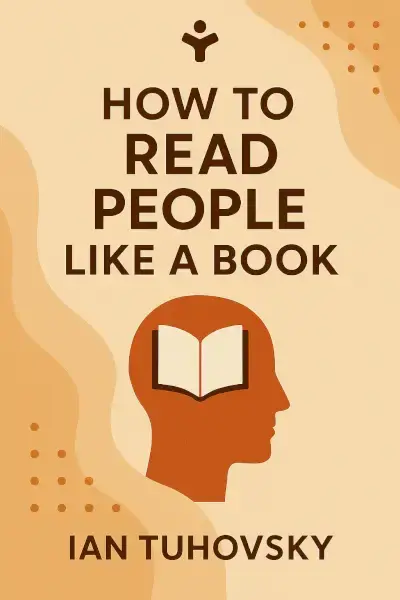
Get the complete 30-minute summary of How to Read People Like a Book
Get the complete summary in the appPersonality exists on a spectrum. Understanding where people fall on that spectrum helps you communicate more effectivel
Body language often reveals more than words. Look for clusters of signals and consider context before interpreting.
Active listening means setting aside your own agenda and focusing fully on understanding the other person.
There is no best communication style. Flexibility and adaptation are more important than any single approach.
Thin-slicing allows accurate snap judgments, but it should be balanced with deliberate analysis.
Self-awareness is the foundation for understanding others. You cannot accurately read people if you do not understand yo
"How to Read People Like a Book" is a strong fit if you want practical ideas around psychology, self help, communication, especially themes like personality exists on a spectrum. understanding where people fall on that spectrum helps you communicate more effectivel; body language often reveals more than words. look for clusters of signals and consider context before interpreting. The MinuteRead summary distills these concepts into a focused read, whether you're deciding whether to buy the book or applying its lessons at work.
James W. Williams is the author of "How to Read People Like a Book." While limited information is available about the author, the book suggests he has some knowledge of psychology, body language, and personality types. Williams focuses on practical applications of these concepts for improving interpersonal communication and understanding. His writing style is described as straightforward and accessible, though some readers note grammatical errors and a lack of depth in his explanations. Williams…
View all summaries by James W. WilliamsContinue Reading
Access the complete 30-minute summary and thousands more nonfiction books in the MinuteRead app.

Continue reading the complete summary in the MinuteRead app.