MinuteRead
30 min
Book summary
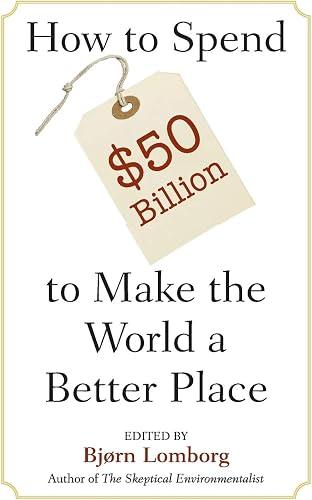
by Bjørn Lomborg
Premium summary · Opens in the app · 30 min read
Imagine you had $50 billion to spend on making the world a better place. Not an abstract sum, but a real commitment. Where would you begin? Would you fight climate change, vaccinate children, provide clean water, reduce trade barriers, or prevent wars? Each cause has passionate advocates. Each addresses genuine suffering. Yet no one, not even the wealthiest government, can fund everything.
**Author:** Bjørn Lomborg
**Estimated Reading Time:** 45 minutes
**What You'll Learn:** How the world's leading economists ranked solutions to humanity's biggest challenges, which interventions deliver the most impact per dollar, and how to think clearly about global priorities.
**Who This Book Is For:** Anyone who wants to understand how resources can be allocated to genuinely improve lives, from policymakers and philanthropists to curious citizens who care about making a difference.
Imagine you had $50 billion to spend on making the world a better place. Not an abstract sum, but a real commitment. Where would you begin? Would you fight climate change, vaccinate children, provide clean water, reduce trade barriers, or prevent wars? Each cause has passionate advocates. Each addresses genuine suffering. Yet no one, not even the wealthiest government, can fund everything. This is the central problem of global development. The world's challenges are enormous, but resources are finite. Every dollar spent on one problem is a dollar not spent on another. And here is the uncomfortable truth: some ways of spending money do far more good than others. A dollar spent on one intervention might save a life, while a dollar spent on another might achieve almost nothing. If we care about actually helping people, we need to know the difference. Most discussions about global problems avoid this reality. They focus on which issues feel most urgent, which causes attract the most attention, or which solutions sound appealing. But urgency and importance are not the same thing. A problem can be deeply troubling and still have no cost-effective solution. Another problem might receive little attention while offering extraordinary opportunities to help. Bjørn Lomborg recognized this gap between good intentions and good outcomes. In 2004, he gathered some of the world's most distinguished economists, including several Nobel laureates, and asked them a simple question: if you had $50 billion to spend on global challenges, how would you prioritize? The result was the Copenhagen Consensus, an ambitious attempt to bring rigorous economic analysis to the world's most pressing problems. The economists examined ten major challenge areas: climate change, communicable diseases, conflicts, education, governance and corruption, malnutrition and hunger, migration, water and sanitation, and trade barriers. For each area, they evaluated specific interventions, calculating costs and benefits as carefully as possible. They did not ask which problems were most serious. They asked which solutions would deliver the most good for the money spent. What emerged was a ranked list of opportunities, some obvious and some surprising. The results challenged conventional wisdom on both the left and the right. They showed that some of the most talked-about problems offered relatively poor returns on investment, while some of the least glamorous interventions could deliver…
Continue reading in the MinuteRead app
Get the complete 30-minute summary of How to Spend $50 Billion to Make the World a Better Place
Get the complete summary in the appPrioritize based on where money can do the most good, not on which problems feel most urgent.
The Copenhagen Consensus ranked interventions using benefit-cost ratios, revealing that some popular causes offer poor r
Communicable disease control, including malaria prevention and HIV prevention, offers benefit-cost ratios of 4 to 50.
Micronutrient supplementation, especially vitamin A, is among the most cost-effective interventions in global health, wi
Trade liberalization could increase global GDP by 1.8%, with developing countries gaining the most.
Preventing conflicts is far cheaper than responding after they erupt. International peacekeeping can deliver benefits wo
"How to Spend $50 Billion to Make the World a Better Place" is a strong fit if you want practical ideas around economics, politics, globalization, especially themes like prioritize based on where money can do the most good, not on which problems feel most urgent; the copenhagen consensus ranked interventions using benefit-cost ratios, revealing that some popular causes offer poor r. The MinuteRead summary distills these concepts into a focused read, whether you're deciding whether to buy the book or applying its lessons at work.
Motivated to help readers with if we had an extra $50 billion to put to good use, Bjørn Lomborg wrote “How to Spend $50 Billion to Make the World a Better Place” to package those ideas for a fast, focused read. In “How to Spend $50 Billion to Make the World a Better Place”, Bjørn Lomborg focuses on if we had an extra $50 billion to put to good use. Through “How to Spend $50 Billion to Make the World a Better Place”, Bjørn Lomborg distills the core ideas on economics into lessons readers can abso…
Continue Reading
Access the complete 30-minute summary and thousands more nonfiction books in the MinuteRead app.

Continue reading the complete summary in the MinuteRead app.