MinuteRead
30 min
Book summary
Premium summary · Opens in the app · 30 min read
We live in a world saturated with promises about artificial intelligence. Every week brings news of another breakthrough: algorithms that detect cancer, systems that translate languages in real time, software that predicts what we will buy before we know ourselves. The message is consistent and seductive. The machines are getting smarter. They will solve our problems. They will make better decisions than we ever could.
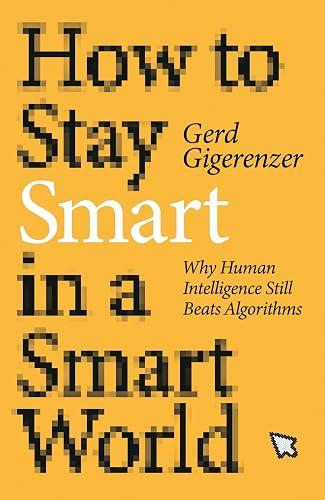
**Author:** Gerd Gigerenzer **Estimated Reading Time:** 45 minutes
**What You'll Learn:**
- Why artificial intelligence excels in some domains and fails in others - How simple rules often beat complex algorithms - Why transparency matters more than predictive power - What the real cost of "free" digital services is - How to protect your attention, privacy, and autonomy - Practical strategies for staying smart in an increasingly smart world
**Who This Book Is For:**
Anyone who uses digital technology and wants to understand what it does well, where it fails, and how to remain in control. If you have ever wondered whether to trust an algorithm, worried about your data, or felt your attention slipping away to your phone, this book is for you.
We live in a world saturated with promises about artificial intelligence. Every week brings news of another breakthrough: algorithms that detect cancer, systems that translate languages in real time, software that predicts what we will buy before we know ourselves. The message is consistent and seductive. The machines are getting smarter. They will solve our problems. They will make better decisions than we ever could. Gerd Gigerenzer has spent his career studying how humans actually make decisions, and he has a different message. The real question, he argues, is not whether machines are smart. The real question is whether we are smart enough to know when to trust them and when to trust ourselves. This book is not anti-technology. Gigerenzer is not asking you to delete your apps or abandon your devices. He is asking something more demanding: that you understand what these systems can and cannot do, where they help and where they harm, and how to remain the one in charge. The problem is that most of us have been taught to think about AI in the wrong way. We imagine intelligence as a single scale, with simple calculators at the bottom and superintelligent machines at the top. On this scale, humans sit somewhere in the middle, soon to be surpassed. But this picture is fundamentally misleading. Intelligence is not one thing. It is a collection of abilities, and different systems have different strengths. A chess computer can defeat the world champion, but it cannot understand a joke. A recommendation algorithm can predict which movie you will enjoy, but it cannot tell you whether watching it is a good use of your evening. A medical AI can spot patterns in millions of scans, but it cannot hold your hand and explain what a diagnosis means for your life. Gigerenzer's central insight is that the value of AI depends entirely on the situation. In stable, well-defined environments where the rules never change and massive amounts…
Continue reading in the MinuteRead app
Get the complete 30-minute summary of How to Stay Smart in a Smart World
Get the complete summary in the appComplex algorithms work best in stable, well-defined environments with lots of data.
Human intelligence evolved to handle uncertainty, where data is often sparse or unreliable.
Simple rules often outperform complex models in uncertain situations.
Transparency is a necessity, not a luxury. An algorithm is transparent if you can understand, memorize, teach, and execu
Free services are not free. You pay with your data, attention, and privacy.
The surveillance business model is a choice, not a technological necessity.
"How to Stay Smart in a Smart World" is a strong fit if you want practical ideas around psychology, science, technology, especially themes like complex algorithms work best in stable, well-defined environments with lots of data; human intelligence evolved to handle uncertainty, where data is often sparse or unreliable. The MinuteRead summary distills these concepts into a focused read, whether you're deciding whether to buy the book or applying its lessons at work.
Motivated to help readers with the stable-world principle: Complex algorithms work best in well-defined, Gerd Gigerenzer wrote “How to Stay Smart in a Smart World” to package those ideas for a fast, focused read. In “How to Stay Smart in a Smart World”, Gerd Gigerenzer focuses on the stable-world principle: Complex algorithms work best in well-defined. Through “How to Stay Smart in a Smart World”, Gerd Gigerenzer distills the core ideas on psychology into lessons readers can absorb in a single s…
View all summaries by Gerd GigerenzerContinue Reading
Access the complete 30-minute summary and thousands more nonfiction books in the MinuteRead app.

Continue reading the complete summary in the MinuteRead app.