MinuteRead
30 min
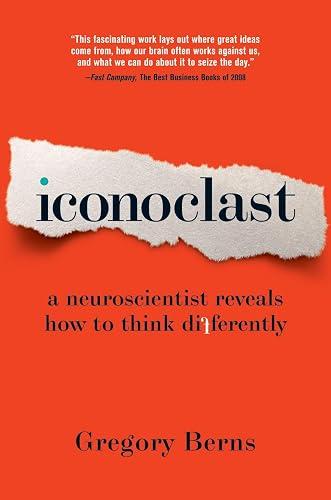
Book summary
by Gregory Berns
Premium summary · Opens in the app · 30 min read
Every breakthrough in human history began the same way. Someone looked at the world and saw something different from everyone else. Not a new landscape, but a new way of seeing the landscape that already existed. The Wright brothers saw a flying machine where others saw a bicycle shop. Florence Nightingale saw a data problem where others saw battlefield chaos. Nolan Bushnell saw a simple game where others saw complex technology.
**Author:** Gregory Berns **Estimated Reading Time:** 38 minutes
Why some people see possibilities where others see only obstacles. How the brain's natural wiring fights against original thinking, and what you can do to overcome those limitations. The three essential traits that allow individuals to challenge conventional wisdom and succeed.
Anyone who has ever had an idea dismissed as impossible. Leaders who want to build teams capable of genuine innovation. Investors who need to resist herd mentality. Creators who struggle with fear of rejection. And anyone curious about why the human brain, so remarkable in its capabilities, so often defaults to the ordinary.
Every breakthrough in human history began the same way. Someone looked at the world and saw something different from everyone else. Not a new landscape, but a new way of seeing the landscape that already existed. The Wright brothers saw a flying machine where others saw a bicycle shop. Florence Nightingale saw a data problem where others saw battlefield chaos. Nolan Bushnell saw a simple game where others saw complex technology. These individuals are iconoclasts. They do what others say cannot be done. But here is the uncomfortable truth that Gregory Berns, a neuroscientist at Emory University, discovered when he began studying these remarkable people: iconoclasts are not born with special brains. They are not genetically gifted with creativity that the rest of us lack. Instead, they have learned, often through accident or circumstance, to use their brains differently. And that difference can be understood, studied, and replicated. Berns approaches this subject from an unusual angle. Most books about innovation focus on business strategy or creative techniques. They offer frameworks and exercises, brainstorming methods and design thinking protocols. Berns starts somewhere else entirely: inside the brain itself. He asks a more fundamental question. What happens in the neural circuitry of someone who sees the world differently? Why do most brains resist novelty? And what can we learn from the exceptions? The answer is both humbling and liberating. The human brain is not designed for iconoclasm. It is designed for efficiency, for pattern recognition, for social conformity. These traits kept our ancestors alive in dangerous environments. They helped us form communities, share knowledge, and avoid unnecessary risks. But these same traits now work against us when we try to think originally. The brain is lazy. It takes shortcuts. It relies on past experience to interpret present reality. It defers to the crowd because the crowd is usually right. It avoids uncertainty because uncertainty feels dangerous. These are not character flaws. They are biological defaults, wired into our neural architecture over millions of years of evolution. Understanding this changes everything. If the barriers to iconoclastic thinking are biological, then they…
Continue reading in the MinuteRead app
Get the complete 30-minute summary of Iconoclast
Get the complete summary in the appIconoclasts see differently. They escape the brain's efficiency traps and perceive possibilities that others miss.
Novelty rewires the brain. Exposing yourself to unfamiliar experiences expands your capacity for creative thinking.
Fear is biological, not personal. The brain's fear system misfires in modern contexts, treating social threats as physic
Reappraisal transforms fear. Changing the meaning of a situation changes the emotional response to it.
The brain is biased against risk. Loss aversion is stronger than the hope of gain, and stress makes it worse.
Conformity is a neural default. The brain defers to the crowd because the crowd is usually right, but this creates group
"Iconoclast" is a strong fit if you want practical ideas around psychology, science, business, especially themes like iconoclasts see differently. they escape the brain's efficiency traps and perceive possibilities that others miss; novelty rewires the brain. exposing yourself to unfamiliar experiences expands your capacity for creative thinking. The MinuteRead summary distills these concepts into a focused read, whether you're deciding whether to buy the book or applying its lessons at work.
Motivated to help readers with the real voyage of discovery lies not in seeking new landscapes but in seeing with new eyes, Gregory Berns wrote “Iconoclast” to package those ideas for a fast, focused read. In “Iconoclast”, Gregory Berns focuses on the real voyage of discovery lies not in seeking new landscapes but in seeing with new eyes. Through “Iconoclast”, Gregory Berns distills the core ideas on psychology into lessons readers can absorb in a single short sitting. Readers turn to this work …
Continue Reading
Access the complete 30-minute summary and thousands more nonfiction books in the MinuteRead app.

Continue reading the complete summary in the MinuteRead app.