MinuteRead
30 min
Book summary
Premium summary · Opens in the app · 30 min read
Every investor believes they are rational. Every investor believes they make decisions based on careful analysis of facts, probabilities, and expected returns. And every investor is wrong.
**Author:** Richard L. Peterson
**Estimated Reading Time:** 45 minutes
**What You'll Learn:** How neuroscience and psychology explain why smart investors make costly mistakes, and how understanding the brain's emotional circuitry can help you become a more disciplined and profitable investor.
**Who This Book Is For:** Individual investors, financial professionals, traders, and anyone who wants to understand why markets behave irrationally and how to protect themselves from their own psychological blind spots.
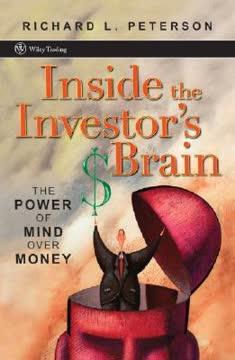
Every investor believes they are rational. Every investor believes they make decisions based on careful analysis of facts, probabilities, and expected returns. And every investor is wrong. The uncomfortable truth that Richard Peterson explores in *Inside the Investor's Brain* is that human beings are not designed for financial markets. Our brains evolved over hundreds of thousands of years to help us survive on the savanna, not to evaluate price-to-earnings ratios or decide whether to hold through a market correction. The neural machinery that kept our ancestors alive now actively works against us when we sit down to manage a portfolio. Consider the evidence. The average mutual fund investor underperforms the very funds they invest in by a significant margin, not because they pick bad funds, but because they buy and sell at the wrong times. They pour money into hot funds after they have already risen, and they panic and sell after markets have fallen. This behavior is so consistent that it has a name: the behavior gap. It represents the cost of emotion-driven decision-making. The problem is not lack of information. Investors today have access to more data, more research, and more analytical tools than at any point in history. The problem is not lack of intelligence either. Some of the most spectacular investment failures in history have involved brilliant people. Long-Term Capital Management employed Nobel Prize-winning economists and still collapsed. Sir Isaac Newton, one of the greatest scientific minds who ever lived, lost a fortune in the South Sea Bubble. Mark Twain, a man of extraordinary wit and insight, made terrible investment decisions throughout his life. What these examples share is not stupidity. It is humanity. Each of these individuals was undone by the same psychological forces that affect every investor: greed, fear, overconfidence, and the inability to recognize when emotions have hijacked rational thought. Peterson's contribution is to bring the tools of neuroscience to bear on this ancient problem. Rather than simply cataloging the ways investors go wrong, he explains why they go wrong at the level of brain structure and function. He shows how the brain's reward system drives us to chase gains, how the loss avoidance system triggers panic during market declines, and how the prefrontal cortex, the seat of rational thought, often loses…
Continue reading in the MinuteRead app
Get the complete 30-minute summary of Inside the Investor's Brain
Get the complete summary in the appYour brain is not designed for financial markets. It evolved for survival on the savanna, not for evaluating stocks and
The anticipation of gains activates the brain's reward center and can override rational risk assessment.
Losses hurt more than gains feel good, which drives panic selling and excessive risk aversion.
Overconfidence leads to excessive trading, poor diversification, and disappointing returns.
Stress impairs rational thinking and shifts decision-making to emotional systems.
Herding behavior drives bubbles and crashes when investors imitate one another.
"Inside the Investor's Brain" is a strong fit if you want practical ideas around finance, psychology, business, especially themes like your brain is not designed for financial markets. it evolved for survival on the savanna, not for evaluating stocks and; the anticipation of gains activates the brain's reward center and can override rational risk assessment. The MinuteRead summary distills these concepts into a focused read, whether you're deciding whether to buy the book or applying its lessons at work.
Richard L. Peterson is the author of "Inside the Investor's Brain," a book that explores the intersection of neuroscience, psychology, and investing. As a professional with experience working with traders and investors, Peterson brings a unique perspective to the field of behavioral finance. His work draws on scientific studies and personal observations to provide readers with insights into how emotions and cognitive biases impact investment decisions. Peterson's approach combines academic resea…
View all summaries by Richard L. PetersonContinue Reading
Access the complete 30-minute summary and thousands more nonfiction books in the MinuteRead app.

Continue reading the complete summary in the MinuteRead app.