MinuteRead
30 min
Book summary
Premium summary · Opens in the app · 30 min read
Imagine you are asked to estimate the likelihood that a particular startup will succeed. You know the founder went to an elite university, speaks confidently, and has a polished pitch deck. You also know that most startups fail. Which information shapes your judgment?
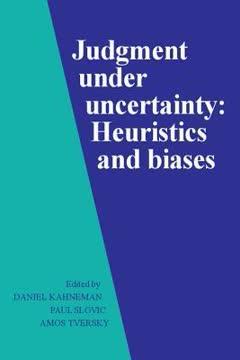
**Author:** Daniel Kahneman (with Paul Slovic and Amos Tversky)
**Estimated Reading Time:** 42 minutes
**What You'll Learn:**
* Why smart people make predictable mistakes when judging probabilities * How three mental shortcuts shape nearly every decision you make * Why experts are often no better at prediction than laypeople * What regression to the mean actually means and why we misunderstand it * How to recognize and correct your own judgment errors
**Who This Book Is For:**
Anyone who makes decisions under uncertainty. That includes investors evaluating stocks, doctors diagnosing patients, judges setting bail, managers hiring employees, and ordinary people deciding whether to buy insurance, change jobs, or trust a news report. If you have ever been certain about something and turned out to be wrong, this book explains why.
Imagine you are asked to estimate the likelihood that a particular startup will succeed. You know the founder went to an elite university, speaks confidently, and has a polished pitch deck. You also know that most startups fail. Which information shapes your judgment? For most people, the founder's credentials and presentation dominate. The base rate, the fact that perhaps nine out of ten startups fail, fades into the background. This is not a minor quirk. It is a fundamental feature of how the human mind works. Daniel Kahneman and Amos Tversky spent decades studying exactly this phenomenon. Their research, collected and expanded in *Judgment Under Uncertainty*, changed how we understand human reasoning. Before their work, the prevailing view in economics and decision theory was that people generally make rational choices based on available information. Errors were thought to be random, caused by emotion or lack of intelligence. Kahneman and Tversky showed something different. Human errors in judgment are not random. They are systematic, predictable, and shared by nearly everyone, including highly trained experts. These errors arise not because people are stupid or careless, but because the mind uses mental shortcuts that work well in many situations but fail in specific, identifiable ways. The book's central insight is deceptively simple. When faced with a difficult question, such as "How likely is this event?" the mind often substitutes an easier question, such as "How easily can I think of examples?" or "How similar is this to what I expected?" This substitution happens automatically, without conscious awareness. The result is a judgment that feels right but may be systematically wrong. Consider a simple demonstration. Ask someone whether there are more words in English that start with the letter "r" or more words that have "r" as the third letter. Most people say there are more words starting with "r." In fact, there are far more words with "r" in the third position. Why…
Continue reading in the MinuteRead app
Get the complete 30-minute summary of Judgment Under Uncertainty
Get the complete summary in the appHeuristics are mental shortcuts that simplify judgments but lead to systematic errors.
Representativeness makes you judge probability by similarity, causing you to neglect base rates.
Availability makes you judge frequency by ease of recall, causing you to overestimate dramatic events.
Anchoring makes your estimates biased toward initial values, even when those values are arbitrary.
Overconfidence is pervasive, and confidence is not a reliable indicator of accuracy.
The illusion of validity creates confidence from consistent but redundant information.
"Judgment Under Uncertainty" is a strong fit if you want practical ideas around psychology, economics, science, especially themes like heuristics are mental shortcuts that simplify judgments but lead to systematic errors; representativeness makes you judge probability by similarity, causing you to neglect base rates. The MinuteRead summary distills these concepts into a focused read, whether you're deciding whether to buy the book or applying its lessons at work.
Daniel Kahneman was an Israeli-American psychologist born in 1934 and died in 2024. He won the 2002 Nobel Memorial Prize in Economic Sciences for his work on behavioral finance and hedonic psychology. Kahneman, along with Amos Tversky and others, established a cognitive basis for common human errors using heuristics and biases, and developed Prospect theory. His research has had a significant impact on the fields of psychology and economics. Kahneman served as a professor emeritus of psychology …
View all summaries by Daniel KahnemanContinue Reading
Access the complete 30-minute summary and thousands more nonfiction books in the MinuteRead app.

Continue reading the complete summary in the MinuteRead app.