MinuteRead
30 min
Book summary
Premium summary · Opens in the app · 30 min read
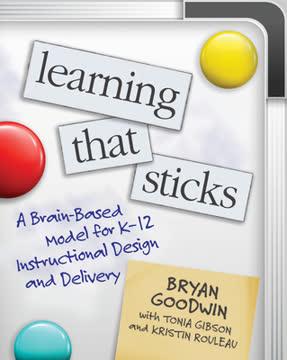
If you wanted to create an education environment that was directly opposed to what the brain was good at doing, you probably would design something like a classroom.
**Author:** Bryan Goodwin
**Estimated Reading Time:** 42 minutes
**What You'll Learn:**
* Why the human brain is naturally wired for learning, and why traditional classrooms often work against that wiring * The six phases of learning that every effective learning experience must move through * How curiosity, emotion, and personal relevance determine whether information sticks * The science behind why some practice methods work and others fail * Practical strategies for designing learning experiences that produce lasting understanding
**Who This Book Is For:**
This book is for anyone who teaches, trains, or designs learning experiences. Classroom teachers will find a research-based framework for improving their practice. Corporate trainers and instructional designers will discover why their carefully crafted presentations sometimes fail to produce lasting results. Parents will gain insight into how their children actually learn. And lifelong learners will discover how to make their own learning efforts more effective and enduring.
If you wanted to create an education environment that was directly opposed to what the brain was good at doing, you probably would design something like a classroom. That observation, which opens Bryan Goodwin's exploration of learning science, captures a profound paradox. The human brain is perhaps the most sophisticated learning machine in the known universe. It constantly filters vast amounts of sensory data, seeks patterns, forms connections, and builds understanding. Yet the environments we have constructed for formal learning often ignore how this remarkable organ actually works. Consider what happens in a typical classroom or training session. Information is delivered in long, uninterrupted lectures. Students sit passively, expected to absorb knowledge through listening alone. Practice, when it happens, is often massed into single sessions rather than distributed over time. Assessment focuses on recognition rather than recall. And the entire experience is frequently disconnected from anything students care about or find personally meaningful. The result is predictable. Students forget most of what they are taught within days or weeks. They develop the belief that they are not good at subjects that were simply taught in ways that worked against their cognitive architecture. Teachers work harder and harder, delivering more content, while learning outcomes remain stubbornly flat. Bryan Goodwin wrote this book to address a fundamental gap. For decades, cognitive scientists have been studying how learning actually works. They have identified the conditions under which information moves from working memory into long-term memory. They have mapped the role of curiosity, emotion, and motivation in the learning process. They have demonstrated which practice strategies produce durable learning and which produce the illusion of mastery. Yet this research has largely remained trapped in academic journals and laboratory settings. Teachers, trainers, and instructional designers rarely encounter it in their professional preparation. They are left…
Continue reading in the MinuteRead app
Get the complete 30-minute summary of Learning That Sticks
Get the complete summary in the appThe brain is naturally curious and learns best when curiosity is engaged.
Learning follows six phases: interest, commitment, focus, sense-making, practice, and application.
Relevance must be made explicit. Learners need to know why material matters to them.
Use both visual and verbal channels to maximize processing capacity.
Active processing is essential. Passive exposure does not produce learning.
Spaced practice, retrieval practice, and interleaved practice produce durable learning.
"Learning That Sticks" is a strong fit if you want practical ideas around teaching, especially themes like the brain is naturally curious and learns best when curiosity is engaged; learning follows six phases: interest, commitment, focus, sense-making, practice, and application. The MinuteRead summary distills these concepts into a focused read, whether you're deciding whether to buy the book or applying its lessons at work.
Bryan Goodwin is an educational researcher, author, and expert in instructional design. As the president and CEO of McREL International, a non-profit education research and development organization, he has extensive experience in translating research into practical strategies for educators. Goodwin's work focuses on improving teaching and learning through evidence-based practices. He has authored several books on education and is a frequent speaker at conferences and professional development eve…
View all summaries by Bryan GoodwinContinue Reading
Access the complete 30-minute summary and thousands more nonfiction books in the MinuteRead app.

Continue reading the complete summary in the MinuteRead app.