MinuteRead
30 min
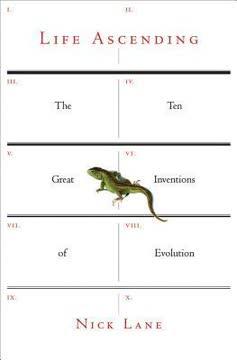
Life appears to violate the laws of physics. It builds order from chaos. It concentrates energy. It creates structures of staggering complexity from simple molecules. For centuries, this apparent defiance of entropy seemed to demand a supernatural explanation. Life was special. Life was different. Life required a spark of divine intervention.
**Author:** Nick Lane **Estimated Reading Time:** 42 minutes
**What You'll Learn**
The ten greatest inventions of life, from its very origin in deep-sea vents to the emergence of consciousness and the evolutionary purpose of death. You will understand how DNA stores the code of life, how photosynthesis transformed a planet, why sex exists despite its enormous costs, how movement and sight reshaped ecosystems, and why hot blood broke the energy barriers that constrain all other organisms. Each chapter reveals not just what happened, but how it happened, at the level of molecules and energy.
**Who This Book Is For**
Anyone who has ever looked at the living world and wondered how it came to be this way. You do not need a biology degree. You need curiosity about the deep questions: Why are we conscious? Why do we age? Why did complex life arise only once? Nick Lane answers these questions by following the energy, tracing how life navigated seemingly impossible barriers through a series of evolutionary inventions that changed everything.
Life appears to violate the laws of physics. It builds order from chaos. It concentrates energy. It creates structures of staggering complexity from simple molecules. For centuries, this apparent defiance of entropy seemed to demand a supernatural explanation. Life was special. Life was different. Life required a spark of divine intervention. Modern biology has dismantled this view, but not by making life seem any less extraordinary. Instead, it has revealed that life's apparent miracles rest on a series of concrete, explicable inventions. Each one solved an impossible problem. Each one opened doors that had been firmly closed. And each one left traces that we can read in the molecular machinery of every living cell. Nick Lane's project in this book is to tell the story of those inventions. Not as a dry catalogue of biological facts, but as a detective story spanning four billion years. The question is not simply what happened, but why it happened, and why it happened only once, or only a few times, in the entire history of the planet. The origin of life itself is the first mystery. For decades, the dominant image was a warm little pond, a primordial soup struck by lightning, spontaneously generating the building blocks of life. But this story has a fatal flaw. Making building blocks is not the same as making life. A pile of bricks is not a house. The real problem is energy. Life requires a continuous flow of energy to maintain its improbable order, and a pond has no such flow. Lane traces the evidence to a far more plausible birthplace: the deep-sea alkaline hydrothermal vents, where warm, hydrogen-rich fluids meet cold, acidic seawater across…
Continue reading in the MinuteRead app
Get the complete 30-minute summary of Life Ascending
Get the complete summary in the appLife began at alkaline hydrothermal vents, powered by natural proton gradients.
DNA's structure makes faithful replication possible, and the genetic code is universal.
Photosynthesis split water and created the oxygen atmosphere that made complex life possible.
The eukaryotic cell arose from a single endosymbiotic event that may have happened only once.
Sex persists despite its twofold cost because genetic recombination defeats parasites.
Movement, powered by actin and myosin, transformed ecosystems and drove evolutionary arms races.
"Life Ascending" is a strong fit if you want practical ideas around science, biology, evolution, especially themes like life began at alkaline hydrothermal vents, powered by natural proton gradients; dna's structure makes faithful replication possible, and the genetic code is universal. The MinuteRead summary distills these concepts into a focused read, whether you're deciding whether to buy the book or applying its lessons at work.
Nick Lane is a British biochemist and author specializing in evolutionary biochemistry and bioenergetics. He is a Reader at University College London and has won several awards for his research and science writing. Lane has authored three acclaimed books on evolutionary biochemistry, translated into multiple languages. His works explore topics like the role of oxygen in life, mitochondria's impact on evolution, and the major innovations in evolutionary history. Lane's writing is known for its ab…
View all summaries by Nick LaneContinue Reading
Access the complete 30-minute summary and thousands more nonfiction books in the MinuteRead app.

Continue reading the complete summary in the MinuteRead app.