MinuteRead
30 min
Book summary
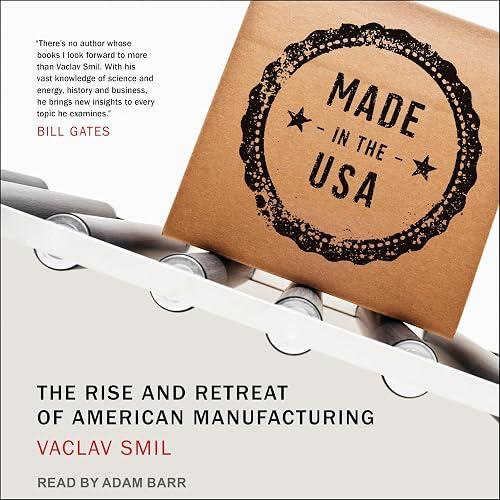
by Vaclav Smil
Premium summary · Opens in the app · 30 min read
The story of American manufacturing is not simply a story about factories. It is the story of how a young nation became the most powerful economic force in human history. It is a story of extraordinary ingenuity, staggering resource consumption, and a willingness to build things at a scale the world had never seen. It is also a story of decline, not because the United States stopped making things, but because the rest of the world learned to make them too, often faster and cheaper.
**Author:** Vaclav Smil
**Estimated Reading Time:** 42 minutes
**What You'll Learn:** How the United States built the most powerful manufacturing engine in history, why that engine began to sputter, and what the decline means for the nation's future. You will understand the forces that drove American industrial dominance, the choices that led to its erosion, and the difficult realities of any attempt to bring it back.
**Who This Book Is For:** Readers who want to understand the real story behind American economic power. This is for anyone who has wondered how the United States became the world's factory, why so many factories left, and whether they can ever return. It is for people who want depth, evidence, and honest analysis rather than slogans.
The story of American manufacturing is not simply a story about factories. It is the story of how a young nation became the most powerful economic force in human history. It is a story of extraordinary ingenuity, staggering resource consumption, and a willingness to build things at a scale the world had never seen. It is also a story of decline, not because the United States stopped making things, but because the rest of the world learned to make them too, often faster and cheaper. Vaclav Smil approaches this story with a perspective that is rare among commentators on American industry. He is not a politician promising a revival. He is not a business consultant selling a turnaround plan. He is a scholar of energy, environment, and technology who has spent decades studying how societies actually produce the things they need. His analysis is grounded in numbers, in tons of steel and barrels of oil, in kilowatt-hours and trade deficits. This gives his account a weight that more rhetorical treatments lack. The central problem Smil addresses is simple to state but difficult to resolve. The United States built its prosperity on manufacturing. For more than a century, making things was the engine of American wealth, the source of good jobs, and the foundation of national power. Then, beginning in the 1970s, that engine began to slow. Factories closed. Jobs disappeared. Entire regions hollowed out. The country did not stop consuming, but it increasingly consumed things made elsewhere. This matters because manufacturing is not just another sector of the economy. It is the sector that creates tangible value, drives innovation, and provides the middle-class jobs that once made the American Dream broadly accessible. When manufacturing retreats, something essential is lost. The consequences ripple through communities, through politics, through the national sense of what is possible. Smil does not offer easy answers. He is deeply skeptical of claims that American manufacturing can be restored to its former glory through…
Continue reading in the MinuteRead app
Get the complete 30-minute summary of Made in the USA
Get the complete summary in the appAmerican manufacturing rose to dominance through abundant resources, technological innovation, and a large domestic mark
The assembly line transformed production and created the mass consumption economy.
The postwar golden age was based on specific conditions that no longer exist.
The 1970s marked the end of American manufacturing dominance.
Offshoring accelerated the decline of manufacturing employment and devastated industrial communities.
China's rise was built on a comprehensive strategy, not just cheap labor.
"Made in the USA" is a strong fit if you want practical ideas around economics, business, history, especially themes like american manufacturing rose to dominance through abundant resources, technological innovation, and a large domestic mark; the assembly line transformed production and created the mass consumption economy. The MinuteRead summary distills these concepts into a focused read, whether you're deciding whether to buy the book or applying its lessons at work.
Motivated to help readers with "Between 1865 and 1900 the annual primary energy use multiplied nearly 12-fold and average per capita use, Vaclav Smil wrote “Made in the USA” to package those ideas for a fast, focused read. In “Made in the USA”, Vaclav Smil focuses on "Between 1865 and 1900 the annual primary energy use multiplied nearly 12-fold and average per capita use. Through “Made in the USA”, Vaclav Smil distills the core ideas on economics into lessons readers can absorb in a single short…
View all summaries by Vaclav SmilContinue Reading
Access the complete 30-minute summary and thousands more nonfiction books in the MinuteRead app.

Continue reading the complete summary in the MinuteRead app.