MinuteRead
30 min
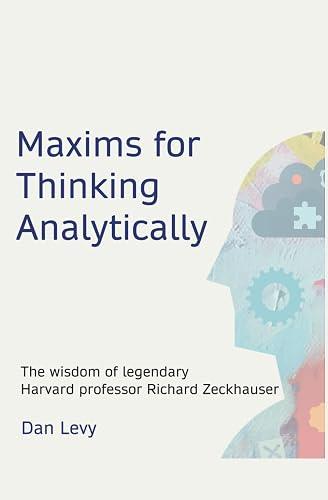
Book summary
by Dan Levy
Premium summary · Opens in the app · 30 min read
Most of us believe we are rational thinkers. We assume that when we face a difficult decision, we weigh the evidence, consider the alternatives, and choose wisely. But the uncomfortable truth is that our minds are not built for clear thinking. We are prone to biases, blind spots, and shortcuts that feel right but often lead us astray.
**Author:** Dan Levy
**Estimated Reading Time:** 45 minutes
**What You'll Learn:** How to think more clearly about complex problems using simple mental tools drawn from economics, decision theory, and policy analysis. You will discover why extreme cases clarify thinking, how to embrace uncertainty without being paralyzed by it, and why good decisions sometimes lead to bad outcomes.
**Who This Book Is For:** Anyone who makes decisions under uncertainty. That includes managers, policymakers, investors, students, and anyone who has ever felt stuck when facing a complicated choice. If you want to sharpen your reasoning and avoid common thinking traps, this book will give you practical tools that work.
Most of us believe we are rational thinkers. We assume that when we face a difficult decision, we weigh the evidence, consider the alternatives, and choose wisely. But the uncomfortable truth is that our minds are not built for clear thinking. We are prone to biases, blind spots, and shortcuts that feel right but often lead us astray. Consider a simple question: Should you switch jobs? The new position pays more but offers less stability. Your current role feels comfortable but stagnant. How do you decide? Most people will go back and forth, listing pros and cons, perhaps asking friends for advice. But without a structured way of thinking, this process often produces anxiety rather than clarity. Dan Levy wrote this book to address a fundamental problem: most people have never been taught how to think analytically. They have absorbed facts and formulas in school, but they have not learned the mental habits that allow them to break down complex problems, weigh uncertainty, and make sound decisions. The result is a world full of smart people making avoidable mistakes. Levy's approach is different. Rather than presenting a complicated framework or a rigid decision-making system, he offers a collection of maxims. These are short, memorable principles that capture deep insights about how the world works and how to think about it. A maxim is not a rule to follow blindly. It is a lens through which to view a problem. It is a prompt that nudges your thinking in a more productive direction. The maxims in this book come from economics, statistics, psychology, and decades of experience in policy analysis. They are the kind of insights that professors at places like Harvard's Kennedy School pass along to students who will go on to make consequential decisions in government, business, and nonprofit organizations. But you do not need to be a policymaker to benefit from them. The same principles that help a government official decide how to allocate a budget can help you decide whether to buy a house, start a business, or simply think…
Continue reading in the MinuteRead app
Get the complete 30-minute summary of Maxims for Thinking Analytically
Get the complete summary in the appWhen stuck, go to an extreme case. It strips away complexity and reveals underlying structure.
The world is uncertain. Think in probabilities, not certainties.
Update your beliefs as new information arrives. Do not anchor on your initial estimates.
The status quo is not safe. It is just familiar. Challenge your preference for the familiar.
Judge decisions by the process, not the outcome. Good decisions can lead to bad results.
Inaction is a choice. Weigh errors of omission as heavily as errors of commission.
"Maxims for Thinking Analytically" is a strong fit if you want practical ideas around psychology, self help, economics, especially themes like when stuck, go to an extreme case. it strips away complexity and reveals underlying structure; the world is uncertain. think in probabilities, not certainties. The MinuteRead summary distills these concepts into a focused read, whether you're deciding whether to buy the book or applying its lessons at work.
Motivated to help readers with when you are having trouble getting your thinking straight, Dan Levy wrote “Maxims for Thinking Analytically” to package those ideas for a fast, focused read. In “Maxims for Thinking Analytically”, Dan Levy focuses on when you are having trouble getting your thinking straight. Through “Maxims for Thinking Analytically”, Dan Levy distills the core ideas on psychology into lessons readers can absorb in a single short sitting. Readers turn to this work when they want …
Continue Reading
Access the complete 30-minute summary and thousands more nonfiction books in the MinuteRead app.

Continue reading the complete summary in the MinuteRead app.