MinuteRead
30 min
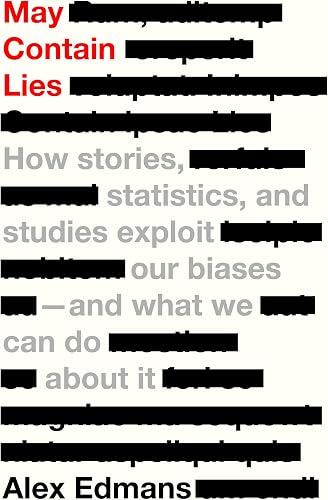
Book summary
by Alex Edmans
Premium summary · Opens in the app · 30 min read
We live in an age of unprecedented access to information. Every day, we encounter hundreds of claims: studies show that coffee prevents cancer, or causes it. A viral post insists that a simple habit will transform your productivity. A podcast guest declares that the economy is about to collapse, or boom. We are bombarded with data, statistics, expert opinions, and compelling stories.
**Author:** Alex Edmans
**Estimated Reading Time:** 42 minutes
**What You'll Learn:**
- Why smart people fall for misinformation despite knowing how to verify facts - The Ladder of Misinference: how statements become facts, facts become data, data becomes evidence, and evidence becomes proof - How confirmation bias and black-and-white thinking distort your judgment before you even begin evaluating claims - Practical tools to scrutinize sources, demand representative samples, and guard against data mining - How to build critical thinking cultures in your personal life, your organization, and society
**Who This Book Is For:**
Anyone who has ever shared an article without reading it. Anyone who has felt certain about a claim only to discover later it was misleading. Anyone who wants to make better decisions in a world drowning in information but starving for wisdom.
The central argument of *May Contain Lies* is deceptively simple: the biggest obstacle to clear thinking is not a lack of information or intelligence. It is our own biases. We like to believe that we evaluate evidence objectively. We think of ourselves as rational beings who weigh facts and reach logical conclusions. But the reality is far messier. Our brains are wired to protect our existing beliefs, to seek comfort in certainty, and to simplify complexity into manageable categories. These tendencies served our ancestors well on the savanna, where quick judgments could mean the difference between life and death. But in the modern world of nuanced information, they often lead us astray. Edmans identifies two pervasive biases that undermine our ability to evaluate claims: confirmation bias and black-and-white thinking. Confirmation bias is the tendency to seek out information that supports what we already believe and to reject information that challenges it. When we encounter a claim that aligns with our worldview, we accept it uncritically. We do not ask whether the source is reliable or whether the evidence is robust. We simply nod along. Conversely, when we encounter a claim that contradicts our beliefs, we become hyper-skeptical. We search for any reason to dismiss it, no matter how flimsy. This is not a conscious choice. It is a neurological response. Studies show that when people are confronted with information that challenges their political beliefs, their amygdala, the brain's threat-detection center, lights up. They experience a fight-or-flight response. Dismissing inconvenient truths, on the other hand, releases dopamine, the brain's reward chemical. Motivated reasoning literally feels good. The result is belief polarization. When two people with opposing views are presented with the same evidence, they often become more entrenched in their positions, not less. Each side interprets the evidence through the lens of their existing beliefs, finding support where the other sees contradiction. Black-and-white thinking compounds the…
Continue reading in the MinuteRead app
Get the complete 30-minute summary of May Contain Lies
Get the complete summary in the appYour biases are the biggest obstacle to clear thinking.
A statement is not a fact. Check the source.
A fact is not data. Demand representative samples.
Data is not evidence. Guard against data mining.
Correlation is not causation. Look for common causes and reverse causation.
Evidence is not proof. Context and range limit universality.
"May Contain Lies" is a strong fit if you want practical ideas around psychology, science, self help, especially themes like your biases are the biggest obstacle to clear thinking; a statement is not a fact. check the source. The MinuteRead summary distills these concepts into a focused read, whether you're deciding whether to buy the book or applying its lessons at work.
Motivated to help readers with knowing how to check the facts isn’t enough, Alex Edmans wrote “May Contain Lies” to package those ideas for a fast, focused read. Through “May Contain Lies”, Alex Edmans distills the core ideas on psychology into lessons readers can absorb in a single short sitting. Readers turn to this work when they want Alex Edmans's perspective on the subject without working through the entire original volume. The book is structured so each chapter highlights a practical lesso…
Continue Reading
Access the complete 30-minute summary and thousands more nonfiction books in the MinuteRead app.

Continue reading the complete summary in the MinuteRead app.