MinuteRead
30 min
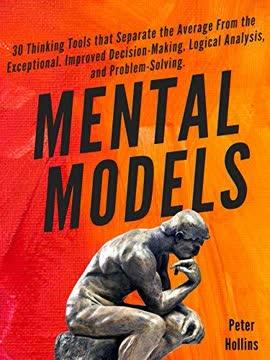
Every day, you make thousands of decisions. Most are small: what to eat, what to wear, which email to answer first. Some are large: whether to take a new job, how to invest your savings, when to trust someone. Yet despite the importance of these choices, most people have never been taught how to think.
**Author:** Peter Hollins
**Estimated Reading Time:** 35 minutes
**What You'll Learn:**
- How to build a latticework of mental models that transforms your decision-making - Why the most urgent tasks are rarely the most important ones - How to think in second and third order consequences - When to act with incomplete information and when to wait - How to use mathematical and scientific thinking in everyday life - Why seeking "good enough" beats chasing perfection - How to avoid the cognitive traps that lead smart people to bad decisions
**Who This Book Is For:**
This book is for anyone who has ever looked back at a decision and wondered what they were thinking. It is for professionals who want to make better calls under pressure, students who want to learn faster, entrepreneurs who need to navigate uncertainty, and anyone who suspects that their thinking could be sharper than it currently is. If you have ever felt overwhelmed by information, paralyzed by choices, or frustrated by repeated mistakes, the mental models in this book will give you a new way to see the world.
Every day, you make thousands of decisions. Most are small: what to eat, what to wear, which email to answer first. Some are large: whether to take a new job, how to invest your savings, when to trust someone. Yet despite the importance of these choices, most people have never been taught how to think. You learned math in school. You learned history, science, and literature. But did anyone ever teach you how to make a decision? Did anyone show you how to evaluate evidence, weigh trade-offs, or anticipate unintended consequences? For most of us, the answer is no. We were expected to pick up these skills on our own, through trial and error, and the results have been predictably mixed. The problem is not a lack of intelligence. Smart people make bad decisions all the time. The problem is a lack of frameworks. Without mental models, even the brightest minds fall back on instinct, emotion, and habit. They react instead of respond. They optimize for the short term and ignore the long term. They see what they expect to see and miss what matters. Peter Hollins argues that the solution is to build what Charlie Munger, the legendary investor and partner of Warren Buffett, called a latticework of mental models. A mental model is a simplified representation of how something works. It is a tool for thinking. Just as a carpenter carries a toolbox with different tools for different jobs, a skilled thinker carries a collection of mental models for different situations. The key insight is that no single model is sufficient. If you only…
Continue reading in the MinuteRead app
Get the complete 30-minute summary of Mental Models
Get the complete summary in the appBuild a latticework of mental models from different disciplines. No single model is sufficient.
Use the Eisenhower Matrix to distinguish between urgent and important tasks. Prioritize the important but not urgent.
Think in second and third order. Consider the consequences of consequences.
Make reversible decisions quickly and irreversible decisions slowly.
Aim for good enough, not perfect. Define your criteria and choose the first option that meets them.
Make decisions with 40% to 70% of the information you need. Less is guessing, more is procrastinating.
"Mental Models" is a strong fit if you want practical ideas around psychology, business, self help, especially themes like build a latticework of mental models from different disciplines. no single model is sufficient; use the eisenhower matrix to distinguish between urgent and important tasks. prioritize the important but not urgent. The MinuteRead summary distills these concepts into a focused read, whether you're deciding whether to buy the book or applying its lessons at work.
Peter Hollins is a bestselling author and researcher specializing in human psychology and behavior. With a background in psychology, including a BS and graduate degree, Hollins focuses on understanding and exploring the human condition. His work aims to provide practical insights into cognitive processes and decision-making. As an author, Hollins has gained recognition for his ability to present complex psychological concepts in an accessible manner. His books, including "Mental Models," often t…
View all summaries by Peter HollinsContinue Reading
Access the complete 30-minute summary and thousands more nonfiction books in the MinuteRead app.

Continue reading the complete summary in the MinuteRead app.