MinuteRead
30 min
Book summary
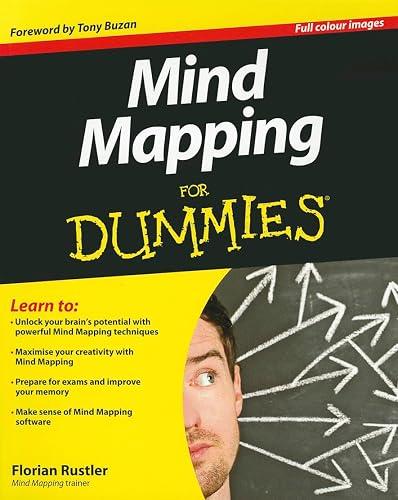
by Florian Rustler
Premium summary · Opens in the app · 30 min read
Every day, you are bombarded with information. Emails pile up. Meetings blur together. Books and articles demand your attention. Lectures deliver facts faster than you can write them down. Projects grow more complex while deadlines creep closer. Your brain is not designed to handle this flood using the tools most people rely on: linear notes, endless lists, and fragmented documents scattered across devices.
**Author:** Florian Rustler
**Estimated Reading Time:** 45 minutes
**What You'll Learn:**
- The core principles that make mind mapping work with your brain, not against it - How to create effective mind maps for learning, work, and creative thinking - When to use pen and paper versus digital mind mapping software - Advanced techniques for building interconnected knowledge systems - Practical applications for exams, projects, meetings, and problem-solving
**Who This Book Is For:**
This book is for anyone who has ever felt overwhelmed by information. Whether you are a student drowning in lecture notes, a professional juggling complex projects, a creative person seeking better ways to capture ideas, or simply someone who wants to think more clearly, mind mapping offers a practical solution. You do not need artistic talent or special training. You only need a willingness to think differently about how you organize what you know.
Every day, you are bombarded with information. Emails pile up. Meetings blur together. Books and articles demand your attention. Lectures deliver facts faster than you can write them down. Projects grow more complex while deadlines creep closer. Your brain is not designed to handle this flood using the tools most people rely on: linear notes, endless lists, and fragmented documents scattered across devices. The problem is not your memory or your intelligence. The problem is the method. Traditional note-taking asks your brain to work in a way that contradicts its natural design. When you write notes in straight lines, you force a multidimensional thinking process into a one-dimensional format. You capture words but lose connections. You record information but miss relationships. You create pages of text that your brain struggles to revisit because nothing about them reflects how you actually think. This is where mind mapping changes everything. A mind map is a visual representation of ideas radiating outward from a central concept. Instead of starting at the top of a page and working downward in lines, you start in the center and branch outward in all directions. Each branch represents a key idea. Each sub-branch represents supporting details. Colors, symbols, and images reinforce meaning. The result is a picture of your thinking that you can grasp at a glance. The technique was popularized by Tony Buzan in the 1970s, but its roots reach deeper. Humans have always thought in associations. One idea triggers another. A memory connects to a feeling. A concept links to an experience. Mind mapping simply makes this associative process visible. Florian Rustler wrote this book to bridge a gap. Many people have heard of mind mapping. Few understand how to use it effectively. They create maps that are cluttered, confusing, or no better than the linear notes they…
Continue reading in the MinuteRead app
Get the complete 30-minute summary of Mind Mapping For Dummies
Get the complete summary in the appMind maps organize information visually, with a central topic and radiating branches, mirroring how your brain naturally
Use one keyword per branch. This forces clarity, enables creative associations, and keeps your map readable.
Add colors, symbols, and images to your maps. These visual elements enhance memory and navigation.
The process of creating a mind map is itself a form of active learning. You cannot create a map without processing the i
Use paper for personal learning and brainstorming. Use software for complex projects, collaboration, and knowledge manag
Mind maps provide a single-page overview of complex projects, showing scope, structure, and status at a glance.
"Mind Mapping For Dummies" is a strong fit if you want practical ideas around science, self help, reference, especially themes like mind maps organize information visually, with a central topic and radiating branches, mirroring how your brain naturally; use one keyword per branch. this forces clarity, enables creative associations, and keeps your map readable. The MinuteRead summary distills these concepts into a focused read, whether you're deciding whether to buy the book or applying its lessons at work.
Motivated to help readers with "Mind Mapping is a visual technique for structuring and organising thoughts and ideas." Visual power unleashed, Florian Rustler wrote “Mind Mapping For Dummies” to package those ideas for a fast, focused read. In “Mind Mapping For Dummies”, Florian Rustler focuses on "Mind Mapping is a visual technique for structuring and organising thoughts and ideas." Visual power unleashed. Through “Mind Mapping For Dummies”, Florian Rustler distills the core ideas on science in…
Continue Reading
Access the complete 30-minute summary and thousands more nonfiction books in the MinuteRead app.

Continue reading the complete summary in the MinuteRead app.