MinuteRead
30 min
Book summary
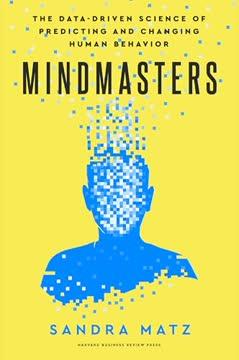
by Sandra Matz
Premium summary · Opens in the app · 30 min read
Sandra Matz grew up in a small village in Germany where everyone knew everyone else's business. Her neighbors could tell you who was having marital troubles, who was struggling financially, and who had a drinking problem. They did not need sophisticated technology to understand the people around them. They simply observed. They noticed the small details: the way someone parked their car, the state of their garden, the timing of their lights going on and off. Over years of living in close proximi
**Author:** Sandra Matz, PhD
**Estimated Reading Time:** 45 minutes
**What You'll Learn:**
- How your digital footprints reveal your deepest psychological traits - Why computers can predict your personality better than your friends and family - The mechanics behind psychological targeting and how it shapes your decisions - The hidden power dynamics of the data economy - Practical strategies for reclaiming control over your digital identity - How data cooperatives could reshape the future of privacy
**Who This Book Is For:**
Anyone who uses a smartphone, browses the internet, or participates in social media. If you have ever wondered why ads seem to know exactly what you are thinking, or felt uneasy about the amount of personal information floating in the digital ether, this book will give you the clarity and tools to understand the invisible machinery shaping your life.
Sandra Matz grew up in a small village in Germany where everyone knew everyone else's business. Her neighbors could tell you who was having marital troubles, who was struggling financially, and who had a drinking problem. They did not need sophisticated technology to understand the people around them. They simply observed. They noticed the small details: the way someone parked their car, the state of their garden, the timing of their lights going on and off. Over years of living in close proximity, these observations accumulated into remarkably accurate psychological profiles. Matz eventually left that village and became a psychologist at Columbia Business School, where she began studying something unexpected: computers were learning to do exactly what her neighbors had done. But instead of observing gardens and parking habits, computers were observing digital footprints. And instead of taking years to form judgments, they were doing it in milliseconds. The premise of Mindmasters is both simple and unsettling. Every time you like a post on Facebook, search for something on Google, make a purchase with your credit card, or carry your smartphone in your pocket, you leave behind traces of who you are. Individually, these traces seem meaningless. A single like on a Facebook page tells you almost nothing about a person. A single Google search might be a momentary curiosity rather than a window into the soul. But when computers aggregate thousands or millions of these traces, patterns emerge. And those patterns reveal something profound. They reveal your personality. Your political leanings. Your sexual orientation. Your mental health. Your socioeconomic status. Your values, fears, and aspirations. They reveal the person you are when no one is watching, and sometimes the person you do not even realize you are. This is not science fiction. It is happening right now, every day, at a scale that is difficult to comprehend. The algorithms…
Continue reading in the MinuteRead app
Get the complete 30-minute summary of Mindmasters
Get the complete summary in the appYour digital footprints reveal your psychology, often more accurately than your friends and family can.
Every search, like, purchase, and movement leaves a trace that can be decoded.
Psychological targeting is already shaping what you buy, believe, and do.
You are not immune to psychological targeting, even if you believe you are.
The control you have over your data is largely an illusion.
Privacy is not about hiding. It is about control over your own life.
"Mindmasters" is a strong fit if you want practical ideas around science, psychology, technology, especially themes like your digital footprints reveal your psychology, often more accurately than your friends and family can; every search, like, purchase, and movement leaves a trace that can be decoded. The MinuteRead summary distills these concepts into a focused read, whether you're deciding whether to buy the book or applying its lessons at work.
Sandra C. Matz, PhD is an assistant professor at Columbia Business School in New York City. Her academic background includes visiting positions at University College Dublin, Stanford Graduate School of Business, and the University of Texas-Austin. Matz holds a PhD in psychology from the University of Cambridge. Her research focuses on the intersection of big data, human behavior, and psychological targeting. As a leading expert in this field, Matz brings a decade of research experience to her wo…
View all summaries by Sandra MatzContinue Reading
Access the complete 30-minute summary and thousands more nonfiction books in the MinuteRead app.

Continue reading the complete summary in the MinuteRead app.