MinuteRead
30 min
Book summary
by Jonah Lehrer
Premium summary · Opens in the app · 30 min read
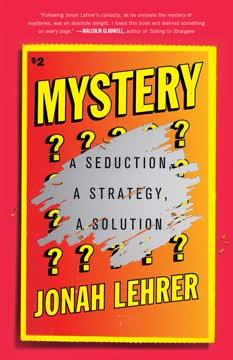
Jonah Lehrer's *Mystery* begins with a simple observation that turns out to be anything but simple: human beings are drawn to what they cannot fully understand. A detective story keeps us turning pages. A half-finished sentence demands completion. A face without a clear expression asks us to imagine what its owner is feeling. The book asks why this is so, and what happens when we stop treating mystery as a problem to be solved and start treating it as a way of seeing.
**Author:** Jonah Lehrer **Estimated Reading Time:** 22 minutes
**What This Story Explores:** The strange pull of the unknown, the way unfinished stories lodge themselves in the mind, and why human beings keep searching for answers they may never find.
**Who This Book Is For:** Readers who have ever stayed up too late because a question would not let them go, who have felt the peculiar thrill of a puzzle without a solution, and who suspect that not knowing is sometimes more alive than certainty.
Jonah Lehrer's *Mystery* begins with a simple observation that turns out to be anything but simple: human beings are drawn to what they cannot fully understand. A detective story keeps us turning pages. A half-finished sentence demands completion. A face without a clear expression asks us to imagine what its owner is feeling. The book asks why this is so, and what happens when we stop treating mystery as a problem to be solved and start treating it as a way of seeing. Lehrer approaches the subject from multiple angles at once. He is interested in neuroscience, in the dopamine systems that light up when we encounter something unexpected. He is interested in evolution, in the possibility that curiosity about the unknown gave our ancestors an advantage when they ventured into unfamiliar territory. He is interested in art, in the way a painting or a poem can remain alive for centuries precisely because it refuses to deliver a single clear meaning. And he is interested in something more personal: the way modern life, with its constant pressure to know, to optimize, to resolve, may be robbing us of a capacity that makes us human. The book is not a novel. It is a work of narrative nonfiction, but it reads with the momentum of a story. Lehrer moves between laboratory experiments and literary criticism, between magic tricks and horror films, between the disappearance of Agatha Christie and the structure of open-ended video games. Each chapter builds on the last, not by arguing a single thesis, but by circling around a central tension: the unknown frightens us, and yet we cannot look away from it. The tone is curious rather than prescriptive. Lehrer writes as someone who has spent years thinking about how the mind works and has come to believe that the most interesting thing about the mind is what it cannot quite grasp. He does not promise that embracing mystery will make readers happier or more successful. He suggests something more subtle: that living with uncertainty is not a failure of understanding, but a different kind of understanding altogether. The central question of the book is whether we can learn to be comfortable with what…
Continue reading in the MinuteRead app
Get the complete 30-minute summary of Mystery
Get the complete summary in the appJonah Lehrer's *Mystery* begins with a simple observation that turns out to be anything but simple: human beings are drawn to what they cannot fully understand. A detective story keeps us turning pages. A half-finished sentence demands comp
"Mystery" will resonate with readers drawn to psychology, mystery, social science. Jonah Lehrer's *Mystery* begins with a simple observation that turns out to be anything but simple: human beings are drawn to what they cannot fully understand. A detective story k… Our summary captures the core argument so you can learn the essentials before committing to the full book.
Jonah Lehrer is a writer known for his work on neuroscience, psychology, and human behavior. He has authored several books, including "Proust Was a Neuroscientist" and "How We Decide." Lehrer's writing style is often described as engaging and accessible, blending scientific research with popular culture references. He has contributed to publications like The New Yorker and Wired. However, Lehrer's career has been marked by controversy, including accusations of plagiarism and fabrication in some …
View all summaries by Jonah LehrerContinue Reading
Access the complete 30-minute summary and thousands more nonfiction books in the MinuteRead app.

Continue reading the complete summary in the MinuteRead app.