MinuteRead
30 min
Book summary
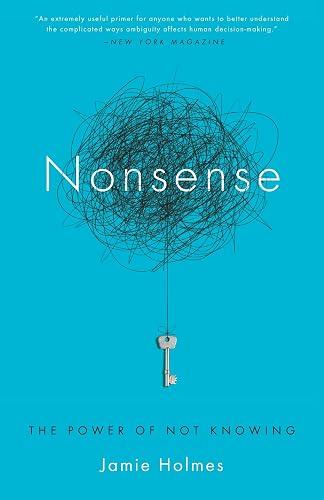
by Jamie Holmes
Premium summary · Opens in the app · 30 min read
In 1989, a police officer named Gary Noesner faced an impossible situation. A man had barricaded himself in a house, armed and threatening violence. The standard playbook called for force. The tactical team was ready. But Noesner, a hostage negotiator, wanted to try something different. He wanted to talk.
**Author:** Jamie Holmes **Estimated Reading Time:** 42 minutes
Why uncertainty makes us uncomfortable, how that discomfort shapes our decisions, and what happens when we learn to sit with ambiguity instead of rushing to resolve it. You'll discover how embracing not knowing can make you more creative, more accurate in your judgments, and more effective in high-pressure situations.
Anyone who has ever felt the urge to make a quick decision just to escape the discomfort of uncertainty. Leaders who want to build teams that think more clearly. Professionals in fields where overconfidence carries real costs. And anyone curious about why some people thrive in ambiguity while others collapse under its weight.
In 1989, a police officer named Gary Noesner faced an impossible situation. A man had barricaded himself in a house, armed and threatening violence. The standard playbook called for force. The tactical team was ready. But Noesner, a hostage negotiator, wanted to try something different. He wanted to talk. The man inside was not a hardened criminal. He was confused, frightened, and deeply ambivalent about what he was doing. Part of him wanted to give up. Part of him wanted to fight. Noesner recognized this ambivalence not as a problem to be overcome but as an opening to be explored. That insight, that willingness to sit with uncertainty rather than force a resolution, saved lives that day. And it points to something fundamental about how our minds work. We are pattern-seeking creatures. Our brains evolved to make sense of the world quickly, to resolve ambiguity before it becomes dangerous. When we encounter something that doesn't fit, something contradictory or unclear, we feel a visceral discomfort. Psychologists call this the need for closure. And most of us will do almost anything to satisfy it. We rush to judgment. We cling to first impressions. We seek out information that confirms what we already believe and ignore what contradicts it. We stereotype. We oversimplify. We convince ourselves that we understand things far better than we actually do. This drive for certainty is not always a problem. In genuinely dangerous situations, quick decisions save lives. But in the modern world, most of the uncertainty we face is not a threat to our survival. It is a signal that we need to think more carefully, consider more possibilities, and resist the urge to settle on an answer before we've truly explored the question. Jamie Holmes wrote this book to explore what happens when we embrace uncertainty instead of fleeing from it. Drawing on research from psychology, neuroscience, medicine, business, and the arts, he shows that our discomfort with ambiguity is not a flaw to be eliminated but a signal to be understood. The argument is…
Continue reading in the MinuteRead app
Get the complete 30-minute summary of Nonsense
Get the complete summary in the appUncertainty is uncomfortable but essential. The discomfort of not knowing is a signal that you are thinking, not a probl
The need for closure is universal. We all feel the urge to resolve uncertainty quickly. The key is managing that urge ra
Stress amplifies the need for closure. The times when we most need to think carefully are the times when careful thinkin
Overconfidence is a constant threat. We consistently overestimate our knowledge and abilities. The gap between confidenc
Ambivalence is wisdom. Holding conflicting feelings simultaneously enables empathy, learning, and creativity.
Creativity requires uncertainty. The willingness to sit with not knowing is essential for generating novel solutions.
"Nonsense" is a strong fit if you want practical ideas around psychology, science, self help, especially themes like uncertainty is uncomfortable but essential. the discomfort of not knowing is a signal that you are thinking, not a probl; the need for closure is universal. we all feel the urge to resolve uncertainty quickly. the key is managing that urge ra. The MinuteRead summary distills these concepts into a focused read, whether you're deciding whether to buy the book or applying its lessons at work.
Motivated to help readers with uncertainty, Jamie Holmes wrote “Nonsense” to package those ideas for a fast, focused read. In “Nonsense”, Jamie Holmes focuses on uncertainty. Through “Nonsense”, Jamie Holmes distills the core ideas on psychology into lessons readers can absorb in a single short sitting. Readers turn to this work when they want Jamie Holmes's perspective on the subject without working through the entire original volume. Jamie Holmes (born April 8, 1980) is an American author. Jam…
Continue Reading
Access the complete 30-minute summary and thousands more nonfiction books in the MinuteRead app.

Continue reading the complete summary in the MinuteRead app.