MinuteRead
30 min
Book summary
by Chrystia Freeland
Premium summary · Opens in the app · 30 min read
For most of the twentieth century, a quiet assumption underpinned Western economic thinking. The assumption was that mature capitalist societies naturally become more equal over time. Industrialization might create sharp disparities at first, but as economies matured, the benefits of growth would spread more broadly. The middle class would expand. The gap between rich and poor would narrow. This was not merely wishful thinking. It was embedded in economic theory, captured in what became known as
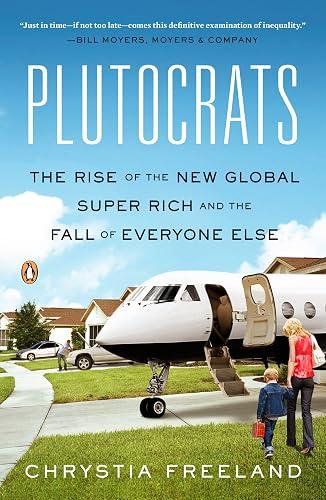
**The Rise of the New Global Super-Rich and the Fall of Everyone Else**
By Chrystia Freeland
**Estimated Reading Time:** 45 minutes
**What You'll Learn:**
- Why the super-rich have pulled away from everyone else since the late 1970s - How the "working rich" replaced the old inherited aristocracy - What the winner-take-all economy means for your career and income - Why rent-seeking has become a primary path to extreme wealth - How plutocrats influence government policy in ways most people never see - What history teaches us about the dangers of concentrated wealth - What can be done to preserve opportunity and economic dynamism
**Who This Book Is For:**
Anyone who wants to understand the tectonic shifts reshaping the global economy. If you have wondered why income inequality has exploded, why the middle class feels squeezed, or how a small group of people came to control such a large share of the world's wealth, this book provides the answers. It is for readers who want to move beyond headlines and understand the deeper forces at work.
For most of the twentieth century, a quiet assumption underpinned Western economic thinking. The assumption was that mature capitalist societies naturally become more equal over time. Industrialization might create sharp disparities at first, but as economies matured, the benefits of growth would spread more broadly. The middle class would expand. The gap between rich and poor would narrow. This was not merely wishful thinking. It was embedded in economic theory, captured in what became known as the Kuznets curve. Then something changed. Beginning in the late 1970s, the trend reversed. In the United States first, and then across the developed world, income inequality began to rise. At first the shift was gradual, easy to dismiss as a temporary blip. But it accelerated through the 1980s and 1990s, and by the early twenty-first century, the numbers had become impossible to ignore. The top 1 percent of Americans now command a share of national income not seen since the 1920s, the era historians call the first Gilded Age. This book is about that reversal and what it means. It is about the people at the top of the new economic order, the plutocrats who have benefited most from the transformation of the global economy. It is about how they made their fortunes, how they think, how they live, and how their rise is reshaping politics, culture, and society. The story is not a simple one. The new super-rich are not the idle heirs of old money. They are, for the most part, hardworking, highly educated, and extraordinarily talented. Many of them have created genuine value. Many of them have built companies that changed the world. In…
Continue reading in the MinuteRead app
Get the complete 30-minute summary of Plutocrats
Get the complete summary in the appWe are living through a second Gilded Age. Income inequality has risen sharply since the late 1970s, reversing a decades
The new plutocrats are the "working rich." They earn their wealth through paid work, not inherited capital. They are the
The winner-take-all economy concentrates rewards at the very top. The gap between the best and the second-best has widen
Rent-seeking, the use of political influence to capture existing wealth, is a major source of extreme wealth. It is not
Cognitive state capture occurs when regulators internalize the perspectives of the industries they oversee. It helps exp
The new plutocrats live in a bubble, isolated from the struggles of ordinary people. This isolation shapes their worldvi
"Plutocrats" is a strong fit if you want practical ideas around economics, politics, business, especially themes like we are living through a second gilded age. income inequality has risen sharply since the late 1970s, reversing a decades; the new plutocrats are the "working rich." they earn their wealth through paid work, not inherited capital. they are the. The MinuteRead summary distills these concepts into a focused read, whether you're deciding whether to buy the book or applying its lessons at work.
Motivated to help readers with economic inequality by Chrystia Freeland, first published in 2012, Chrystia Freeland wrote “Plutocrats” as a practical guide drawn from years of experience and research. Through “Plutocrats”, Chrystia Freeland distills the core ideas on economics into lessons readers can absorb in a single short sitting. Readers turn to this work when they want Chrystia Freeland's perspective on the subject without working through the entire original volume. The book is structured …
Continue Reading
Access the complete 30-minute summary and thousands more nonfiction books in the MinuteRead app.

Continue reading the complete summary in the MinuteRead app.