MinuteRead
30 min
Every day, you make decisions involving prices. You decide whether a cup of coffee is worth four dollars. You negotiate a salary. You choose between insurance plans. You bid on eBay. You tip a server. You haggle over a car. Each of these decisions feels rational. You weigh costs and benefits. You consider what you can afford. You compare options.
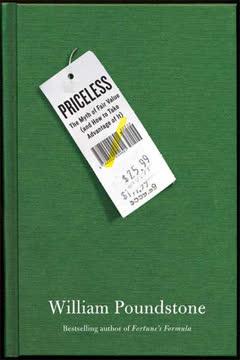
**The Myth of Fair Value (and How to Take Advantage of It)**
By William Poundstone
**Estimated Reading Time:** 45 minutes
**What You'll Learn**
Why prices are not the solid, logical numbers they appear to be. How anchoring, framing, and fairness perceptions shape every financial decision you make. What the ultimatum game reveals about human nature. How businesses exploit cognitive biases in pricing. How to recognize these forces and use them to your advantage.
**Who This Book Is For**
Anyone who has ever wondered why a $7,000 handbag makes a $2,000 bag seem reasonable. Negotiators who want to understand the hidden power of the first number. Consumers who want to make better financial decisions. Professionals in marketing, sales, and pricing who want to understand the psychology behind the numbers. Anyone curious about why humans make the economic choices they do.
Every day, you make decisions involving prices. You decide whether a cup of coffee is worth four dollars. You negotiate a salary. You choose between insurance plans. You bid on eBay. You tip a server. You haggle over a car. Each of these decisions feels rational. You weigh costs and benefits. You consider what you can afford. You compare options. But beneath this sense of rationality lies something strange and unsettling. The numbers that make our world go around are not so solid, immutable, and logically grounded as they appear. Prices are not discovered through some objective process. They are not the inevitable result of supply meeting demand. They are, to a surprising degree, arbitrary constructions that we collectively agree to treat as real. William Poundstone's *Priceless* explores this hidden world of price psychology. Drawing on decades of research in behavioral economics, psychology, and decision theory, Poundstone reveals how easily our sense of value can be manipulated. He shows that most people have no innate sense of what things should cost. Instead, we rely on contextual cues, comparisons, and mental shortcuts that can be exploited. This matters because prices govern nearly every aspect of modern life. They determine what we buy, where we work, where we live, and how we plan for the future. If prices are more malleable than we think, then our decisions based on those prices are also more malleable than we would like to admit. The problem is not simply that prices are arbitrary. The deeper issue is that this arbitrariness is hidden from us. We experience our judgments of value as stable and well-reasoned. We feel confident that we know a good deal when we see one. Yet experiments consistently show that our sense of value can be shifted by irrelevant numbers, subtle changes in wording, and social cues we barely notice. Consider a simple question:…
Continue reading in the MinuteRead app
Get the complete 30-minute summary of Priceless
Get the complete summary in the app**Prices are arbitrary, not objective.** There is no cosmic scale that determines what things should cost. Value is a so
**Anchoring shapes every negotiation.** The first number presented dramatically influences the final outcome. Make the f
**Fairness overrides rationality.** People reject unfair offers even when rejection costs them money.
**Framing changes choices.** The same options presented differently lead to different decisions. Loss frames are more mo
**Losses loom larger than gains.** The pain of losing is greater than the pleasure of gaining.
**The endowment effect makes us overvalue what we own.** We demand more to sell than we would pay to buy.
"Priceless" is a strong fit if you want practical ideas around psychology, business, economics, especially themes like **prices are arbitrary, not objective.** there is no cosmic scale that determines what things should cost. value is a so; **anchoring shapes every negotiation.** the first number presented dramatically influences the final outcome. make the f. The MinuteRead summary distills these concepts into a focused read, whether you're deciding whether to buy the book or applying its lessons at work.
William Poundstone is an accomplished non-fiction author with over ten books to his name. His work often explores the intersection of science, economics, and human behavior. Poundstone's writing has appeared in prestigious publications like The New York Times and Harvard Business Review. He has also made numerous media appearances to discuss his ideas. With a background in physics from MIT, Poundstone brings a scientific perspective to complex social and financial topics. His books have achieved…
View all summaries by William PoundstoneContinue Reading
Access the complete 30-minute summary and thousands more nonfiction books in the MinuteRead app.

Continue reading the complete summary in the MinuteRead app.