MinuteRead
30 min
Book summary
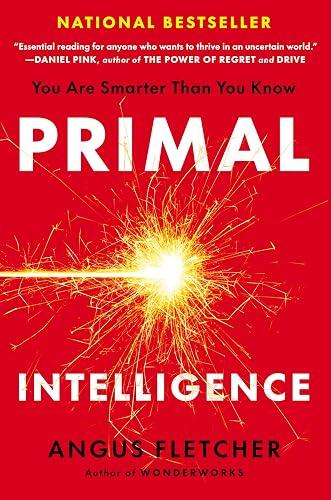
by Angus Fletcher
Premium summary · Opens in the app · 30 min read
Fletcher's central claim is that the modern world wrongly equates intelligence with logic, the AND-OR-NOT operations Aristotle identified that now power arithmetic, statistics, and every algorithm.
**Author:** Angus Fletcher
**Estimated Reading Time:** 45 minutes
**What You'll Learn:** Why the modern obsession with logic has blinded us to the brain's most powerful capabilities, how intuition, imagination, emotion, and commonsense actually work, and practical techniques to recover these primal powers for better decisions, stronger leadership, and genuine innovation.
**Who This Book Is For:** Anyone who suspects that our education system, workplaces, and technology have trained us to think like machines rather than humans. If you want to make better decisions under uncertainty, lead with vision, communicate persuasively, or simply understand what makes human intelligence unique, this book will change how you see your own mind.
We have been sold a lie about intelligence. For centuries, Western civilization has equated smartness with logic. The ability to reason step by step, to calculate, to follow rules, to process data and reach conclusions. This definition of intelligence traces back to Aristotle, who identified the logical operations of AND, OR, and NOT that now power every computer, every algorithm, every statistical model. We have built our schools around this vision. We have built our economy around it. We have built our sense of human worth around it. And it is only half the story. The problem is not that logic is useless. Logic is extraordinarily powerful when it has abundant data. Give a computer millions of examples and it will find patterns no human could spot. Give a statistician clean data and she will extract insights that transform industries. The problem is that real life rarely offers abundant data. Real life is messy, unpredictable, and starved of information. The most important decisions we make, whom to marry, whether to start a business, how to respond to a crisis, happen in conditions of radical uncertainty. And in those conditions, logic fails. Evolution understood this long before Aristotle came along. The human brain evolved over millions of years to make smart decisions with almost no information. Our ancestors could not run statistical analyses on whether a rustling bush hid a predator. They could not gather large datasets on which berries were safe to eat. They needed a different kind of intelligence, one that could act wisely on a single observation, one that could generate plans from imagination rather than data, one that could sense danger before it arrived. This is Primal Intelligence. Primal Intelligence is the brain's original operating system, the cognitive machinery that allowed humans to survive and thrive in environments where information was scarce and stakes were high. It has four components: intuition, imagination, emotion, and commonsense. Each of these has been dismissed by our logic-obsessed culture as unreliable, irrational, or childish. Each of them is actually a sophisticated problem-solving system that…
Continue reading in the MinuteRead app
Get the complete 30-minute summary of Primal Intelligence
Get the complete summary in the appYour brain has two intelligence systems. Logic needs abundant data. Primal Intelligence works with little or no data. Us
Intuition is exception hunting. Look for what violates the pattern. The anomaly is where the future lives.
Plan with defined strategy, unlimited tactics. One clear goal, many flexible paths.
Read emotions as signals. Fear means no plan. Anger means one plan. Grief means split world. Shame means acted against y
Use anxiety as a signal that you have hit the edge of your knowledge. Focus on the next task, not the distant future.
Innovate by holding rule and exception in tension until a synthesis emerges. Do not rush to resolution.
"Primal Intelligence" is a strong fit if you want practical ideas around psychology, self help, science, especially themes like your brain has two intelligence systems. logic needs abundant data. primal intelligence works with little or no data. us; intuition is exception hunting. look for what violates the pattern. the anomaly is where the future lives. The MinuteRead summary distills these concepts into a focused read, whether you're deciding whether to buy the book or applying its lessons at work.
Motivated to help readers with fletcher's central claim is that the modern world wrongly equates intelligence with logic, Angus Fletcher wrote “Primal Intelligence” to package those ideas for a fast, focused read. In “Primal Intelligence”, Angus Fletcher focuses on fletcher's central claim is that the modern world wrongly equates intelligence with logic. Through “Primal Intelligence”, Angus Fletcher distills the core ideas on psychology into lessons readers can absorb in a single short sitting. …
Continue Reading
Access the complete 30-minute summary and thousands more nonfiction books in the MinuteRead app.

Continue reading the complete summary in the MinuteRead app.