MinuteRead
30 min
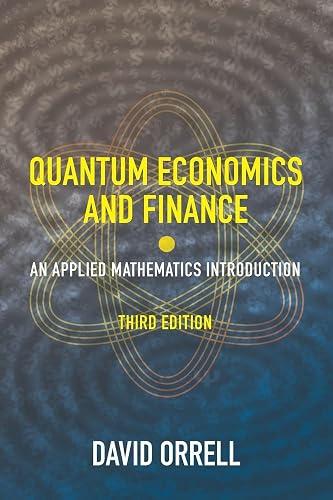
Book summary
by David Orrell
Premium summary · Opens in the app · 30 min read
Every few years, the world economy does something that the experts said was impossible. A housing bubble collapses and takes the global financial system down with it. A pandemic disrupts supply chains in ways no model anticipated. A cryptocurrency rises from nothing to be worth trillions, then loses half its value in a month. Each time, economists scramble to explain what happened. Each time, the explanations sound suspiciously like excuses.
**Author:** David Orwell
**Estimated Reading Time:** 45 minutes
**What You'll Learn:** How the strange rules of quantum physics offer a more accurate lens for understanding money, markets, and economic behavior than the mechanical models that dominate mainstream economics.
**Who This Book Is For:** Anyone who has sensed that something is deeply wrong with the way we think about economics, from the failure to predict financial crises to the obsession with GDP growth at any cost. You do not need a background in physics or economics to follow the ideas in this book.
Every few years, the world economy does something that the experts said was impossible. A housing bubble collapses and takes the global financial system down with it. A pandemic disrupts supply chains in ways no model anticipated. A cryptocurrency rises from nothing to be worth trillions, then loses half its value in a month. Each time, economists scramble to explain what happened. Each time, the explanations sound suspiciously like excuses. The problem is not that economists are unintelligent. The problem is that they are working with the wrong mental model. For more than a century, mainstream economics has treated the economy as if it were a machine. The machine has parts called rational consumers, firms, and markets. These parts interact according to fixed laws, much like planets orbiting the sun. If you understand the laws, you can predict the behavior. If the machine breaks, you fix it with the right policy adjustment. This mechanical worldview came directly from classical physics. The founders of modern economics, figures like William Stanley Jevons and Léon Walras in the late nineteenth century, explicitly modeled their theories on Newtonian mechanics. They wanted economics to be a science, and in their era, science meant physics. So they borrowed the mathematics, the metaphors, and the assumptions. They imagined an economy of independent particles, each responding to forces of supply and demand, settling into equilibrium like a ball rolling to the bottom of a bowl. There was just one problem. The economy does not behave like a machine. It behaves more like a living system, or perhaps something even stranger. David Orwell, a mathematician with a doctorate from Oxford, proposes a radical alternative. Instead of borrowing from classical physics, economics should borrow from quantum physics. In the quantum world, particles do not have fixed positions until they are measured. Observers affect the systems they observe. Entities can be entangled, so that what happens to one instantly affects another, no matter how far apart they are. Uncertainty is not a flaw in measurement but a fundamental feature of reality. Orwell argues that money itself is a quantum phenomenon. A coin is a physical object you can hold…
Continue reading in the MinuteRead app
Get the complete 30-minute summary of Quantum Economics
Get the complete summary in the appMoney has both particle-like and wave-like properties, just like quantum entities.
The economy is an entangled system, not a collection of independent actors.
Mainstream economics is built on a mechanical worldview that is fundamentally flawed.
Financial transactions are acts of measurement that change the system.
Human decision-making follows quantum logic, not classical rationality.
Banks create money when they make loans, and most money is debt-based.
"Quantum Economics" is a strong fit if you want practical ideas around economics, finance, physics, especially themes like money has both particle-like and wave-like properties, just like quantum entities; the economy is an entangled system, not a collection of independent actors. The MinuteRead summary distills these concepts into a focused read, whether you're deciding whether to buy the book or applying its lessons at work.
Motivated to help readers with money objects such as coins, David Orrell wrote “Quantum Economics” to package those ideas for a fast, focused read. In “Quantum Economics”, David Orrell focuses on money objects such as coins. Through “Quantum Economics”, David Orrell distills the core ideas on economics into lessons readers can absorb in a single short sitting. Readers turn to this work when they want David Orrell's perspective on the subject without working through the entire original volume. Da…
Continue Reading
Access the complete 30-minute summary and thousands more nonfiction books in the MinuteRead app.

Continue reading the complete summary in the MinuteRead app.