MinuteRead
30 min
Book summary
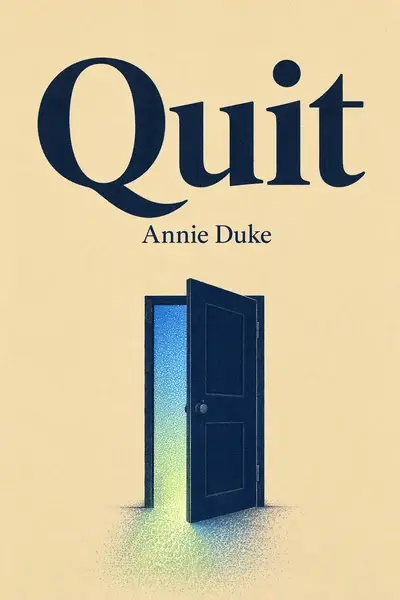
by Annie Duke
Premium summary · Opens in the app · 30 min read
We have been taught a lie. It is a lie repeated so often and with such conviction that most of us have never stopped to question it. The lie is that quitting is for losers. That winners never quit. That grit, persistence, and unwavering commitment are the only paths to success.
**Author:** Annie Duke
**Estimated Reading Time:** 45 minutes
**What You'll Learn:**
- Why quitting is a skill worth mastering, not a weakness to hide - How to recognize the cognitive traps that keep you stuck - Practical frameworks for deciding when to walk away - How to build flexibility into your goals without losing ambition - Ways to separate your identity from your pursuits so you can make clearer choices
**Who This Book Is For:**
Anyone who has ever stayed in a job too long, poured money into a failing project, remained in an unfulfilling relationship, or felt trapped by a goal they set years ago. If you have ever wondered whether persistence is helping or hurting you, this book will change how you think about walking away.
We have been taught a lie. It is a lie repeated so often and with such conviction that most of us have never stopped to question it. The lie is that quitting is for losers. That winners never quit. That grit, persistence, and unwavering commitment are the only paths to success. This message surrounds us. We celebrate the entrepreneur who mortgaged everything and refused to give up. We admire the athlete who played through pain. We praise the student who stayed up all night to finish a project that no longer made sense. We tell ourselves that the moment we feel like quitting is the moment we need to push harder. But what if that advice is not just incomplete but actively harmful? Annie Duke spent two decades as a professional poker player, a world where knowing when to fold is not optional. In poker, the player who cannot fold loses everything. The player who clings to a hand because they have already put chips in the pot is the player who goes broke. Poker taught Duke something that most of us never learn: quitting is a skill. It is a decision-making tool. And in an uncertain world, it may be the most important tool we have. The problem is not that we persist. Persistence is valuable. The problem is that we persist blindly. We persist because we have already invested time, money, or effort. We persist because we told everyone we would succeed. We persist because quitting feels like admitting we were wrong. We persist because we have confused who we are with what we are doing. This book is not an argument for giving up easily. It is an argument for quitting intelligently. There is a profound difference between quitting because something is hard and quitting because something is no longer worth doing. The first is a failure of character. The second is a triumph of judgment. Consider the story…
Continue reading in the MinuteRead app
Get the complete 30-minute summary of Quit
Get the complete summary in the appQuitting is a skill, not a weakness. It allows you to adapt to change.
The sunk cost fallacy keeps you stuck. Past investment is irrelevant to future decisions.
Waste is continuing to invest in something no longer worthwhile. Quitting stops the waste.
Failure is persisting with a poor strategy. Quitting at the right time is a success.
Every goal needs an "unless" condition. Build flexibility into your commitments.
Your identity is not your pursuit. Cultivate a flexible self-concept.
"Quit" is a strong fit if you want practical ideas around psychology, business, self help, especially themes like quitting is a skill, not a weakness. it allows you to adapt to change; the sunk cost fallacy keeps you stuck. past investment is irrelevant to future decisions. The MinuteRead summary distills these concepts into a focused read, whether you're deciding whether to buy the book or applying its lessons at work.
Annie Duke is a decision-making expert and co-founder of The Alliance for Decision Education, a non-profit dedicated to improving lives through decision skills education. She serves on the boards of several organizations, including the National Board of After-School All-Stars and the Franklin Institute. In 2020, Duke joined the board of the Renew Democracy Initiative. Her background as a professional poker player informs her work on decision-making strategies. Duke's expertise in cognitive psych…
View all summaries by Annie DukeContinue Reading
Access the complete 30-minute summary and thousands more nonfiction books in the MinuteRead app.

Continue reading the complete summary in the MinuteRead app.