MinuteRead
30 min
Book summary
by Scott Adams
Premium summary · Opens in the app · 30 min read
Scott Adams spent decades drawing Dilbert, a comic strip about office life that resonated with millions because it captured something true about human nature. But Adams is not just a cartoonist. He is a trained hypnotist, a student of persuasion, and someone who lost his voice to a rare condition called spasmodic dysphonia and had to figure out how to speak again. He has also lost and rebuilt careers, navigated public controversy, and spent years studying why some people thrive while others rema
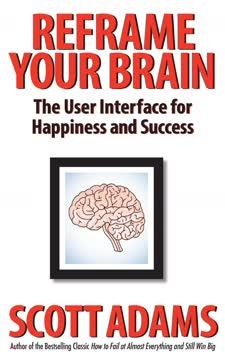
**Reframe Your Brain** *The User's Guide to Reprogramming Your Reality*
By Scott Adams
**Estimated Reading Time:** 45 minutes
**What You'll Learn**
The human brain runs on software. Most of us never update it. We inherit our mental programming from parents, peers, and culture, then wonder why we feel stuck, anxious, or unfulfilled. This book provides the upgrade. You will learn how to install new mental frames that change how you experience work, relationships, setbacks, and your own inner world. These reframes do not need to be true. They do not need to be logical. They only need to work.
**Who This Book Is For**
This book is for anyone who suspects their own thinking might be the problem. It is for the anxious teenager who wants confidence, the entrepreneur who just watched a business collapse, the professional who cannot stop worrying what others think, and the person who has tried self-improvement and found it exhausting. If you have ever wished you could simply think differently about something that bothers you, this book shows you how.
Scott Adams spent decades drawing Dilbert, a comic strip about office life that resonated with millions because it captured something true about human nature. But Adams is not just a cartoonist. He is a trained hypnotist, a student of persuasion, and someone who lost his voice to a rare condition called spasmodic dysphonia and had to figure out how to speak again. He has also lost and rebuilt careers, navigated public controversy, and spent years studying why some people thrive while others remain stuck. His conclusion is surprisingly simple. The difference often comes down to the mental frames people use. A frame is the lens through which you interpret reality. Two people can experience the same event. One sees disaster. The other sees opportunity. One feels victimized. The other feels challenged. The event is identical. The frame is different. And the frame determines everything that follows: the emotions, the decisions, the actions, the results. Most of us treat our frames as if they are fixed features of reality. We think our interpretations are simply accurate readings of the world. But frames are chosen. They can be swapped. And the right frame, installed at the right moment, can transform a situation from unbearable to manageable, or from manageable to extraordinary. Adams does not approach this as a therapist or a philosopher. He approaches it as an engineer. He wants to know what works. He does not care whether a reframe is true in some objective sense. He cares whether it produces better outcomes. If believing something slightly inaccurate makes you healthier, happier, and more effective, then that belief is useful. Truth is not the standard. Utility…
Continue reading in the MinuteRead app
Get the complete 30-minute summary of Reframe Your Brain
Get the complete summary in the appReframes do not need to be true. They only need to work.
Build systems, not goals. Systems give you daily wins.
Combine skills into a talent stack. You do not need to be the best at one thing.
Manage your energy, not your time. Match tasks to your energy levels.
Everyone is too busy with their own lives to judge you. Relax.
Failure is data. Collect it and keep moving.
"Reframe Your Brain" is a strong fit if you want practical ideas around psychology, self help, personal development—especially themes like reframes do not need to be true. they only need to work; build systems, not goals. systems give you daily wins. The MinuteRead summary distills these concepts into a focused read, whether you're deciding whether to buy the book or applying its lessons at work.
Scott Adams is best known as the creator of the Dilbert comic strip. Born in 1957, he holds degrees in Economics and an MBA. Adams has faced health challenges, including focal dystonia and spasmodic dysphonia, which have affected his drawing and speech. He has explored various treatments and developed workarounds for these conditions. Beyond cartooning, Adams is a trained hypnotist and has authored several books on personal development and persuasion. His observational skills and understanding o…
View all summaries by Scott AdamsContinue Reading
Access the complete 30-minute summary and thousands more nonfiction books in the MinuteRead app.

Continue reading the complete summary in the MinuteRead app.