MinuteRead
30 min
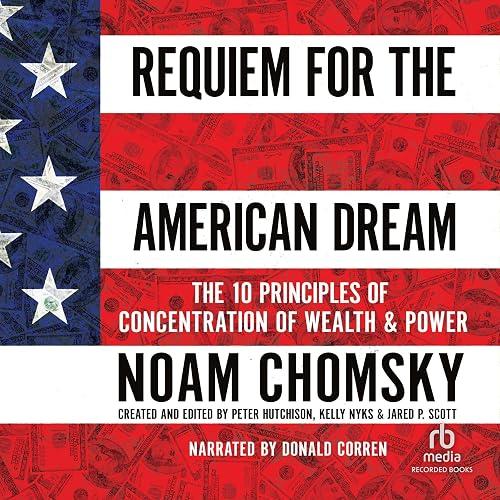
Book summary
by Noam Chomsky
Premium summary · Opens in the app · 5 min read
Requiem For The American Dream argues that the gap between the wealthy and the poor is not an accident, but rather the result of intentional policy decisions made by rich individuals and corporations to increase their power and decrease that of ordinary citizens.
Requiem For The American Dream argues that the gap between the wealthy and the poor is not an accident, but rather the result of intentional policy decisions made by rich individuals and corporations to increase their power and decrease that of ordinary citizens.
Over the last 40 years, income inequality in the United States has grown to shocking proportions. While there are many areas of the socio-economic environment of the USA that went downhill, deregulation, privatization and even globalization played a critical role in the process.
Financial institutions have become vastly more powerful than governments or corporations while also controlling much of their revenue streams—from taxes on investment income to fees paid by consumers who purchase credit cards or take out mortgages.
In other words, as everything is privatized, governments now rely on the financial industry for a large portion of their revenue while financial companies rely on governments for stability. The problem? The working class is carrying the burden of these rushed decisions.
Deregulation is another problem because it allows banks to charge higher interest rates, issue misleading statements, and overall protect corporations in exchange for more profits. These macro-organizations know that they may be skipping the law at certain times, but that doesn’t impose a problem for them anymore.
We can see this phenomenon occurring as corporations are bashing unions and targeting their leaders. As employees start to speak up about issues at work, their voices are often silenced by the officials while their unions are dissolved. The lives of these people often get destroyed, while executives get away with it.
Noam Chomsky argues that globalization allowed corporations to import from low-income countries and grow even more powerful. Tax cuts for the rich and offshoring assets become a norm for every wealthy individual. Including organization that wants to maintain wealth, while the possibility doesn’t even exist for middle-income families. Government spending on such families or poorer people lowered significantly. While the remaining budget helped support these companies in exchange for a place in their world. These tax cuts allowed corporations to grow richer but also pushed families into poverty. For example, Chomsky says that in his view “the income tax has been converted into a device for subsidizing the rich.” How come? Well, the entire system of taxation works for the high-income profiles, as the money keeps on being redistributed upwards. Simply put, the system taxes working people at a higher rate than it does corporations or wealthy individuals. Even more, government spending on families was reduced to help support these companies, all while the middle class shrank and the poor one grew. American workers are left behind as corporations prefer to outsource jobs to other countries where…
Continue reading in the MinuteRead app
Get the complete 5-minute summary of Requiem For The American Dream
Get the complete summary in the appDeregulating can shake a democracy, and over-privatization can weaken governments
Globalization and reduced government spending on families is another main reason behind the increase in poverty
Democracy is at the core of the American system, but it seems to stop at the corporational level
"Requiem For The American Dream" is a strong fit if you want practical ideas around culture, economics, history, especially themes like deregulating can shake a democracy, and over-privatization can weaken governments; globalization and reduced government spending on families is another main reason behind the increase in poverty. The MinuteRead summary distills these concepts into a focused read, whether you're deciding whether to buy the book or applying its lessons at work.
Avram Noam Chomsky (/ˈnoʊm ˈtʃɒmski/; born December 7, 1928) is an American linguist, philosopher, cognitive scientist, historian, logician, social critic, and political activist. Sometimes described as "the father of modern linguistics", Chomsky is also a major figure in analytic philosophy, and one of the founders of the field of cognitive science. He has spent more than half a century at the Massachusetts Institute of Technology (MIT), where he is Institute Professor Emeritus, and is the auth…
View all summaries by Noam ChomskyContinue Reading
Access the complete 5-minute summary and thousands more nonfiction books in the MinuteRead app.

Continue reading the complete summary in the MinuteRead app.