MinuteRead
30 min
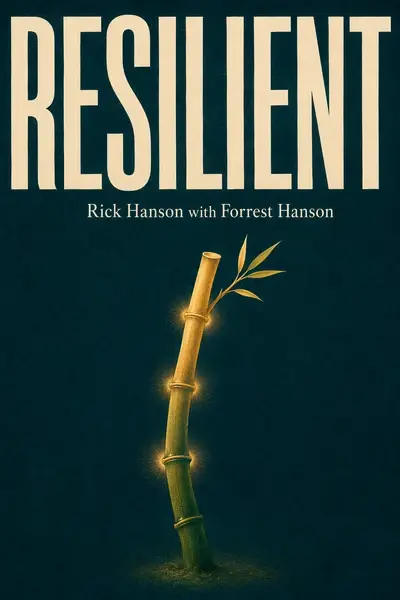
Book summary
by Rick Hanson
Premium summary · Opens in the app · 30 min read
Life has a way of testing us. The phone rings with bad news. A relationship fractures. A job disappears. Health falters. Dreams collide with reality. In these moments, the difference between those who crumble and those who carry on is not luck or circumstance. It is something deeper. It is resilience.
**Author:** Rick Hanson, Ph.D.
**Estimated Reading Time:** 45 minutes
**What You'll Learn:**
- How to build lasting inner strength through deliberate mental practice - Why compassion, grit, and gratitude form the foundation of resilience - Practical techniques for regulating emotions and managing stress - How to cultivate confidence, intimacy, and authentic communication - A complete framework for turning positive experiences into permanent psychological resources
**Who This Book Is For:**
This book is for anyone who has ever felt overwhelmed by life's challenges and wondered if they could handle more. It is for people who want to stop merely surviving and start growing through difficulty. It is for those who sense that resilience is not something you are born with, but something you can deliberately cultivate. Whether you are navigating career setbacks, relationship struggles, health challenges, or simply the accumulated wear of daily stress, this book offers a scientifically grounded path toward genuine inner strength.
Life has a way of testing us. The phone rings with bad news. A relationship fractures. A job disappears. Health falters. Dreams collide with reality. In these moments, the difference between those who crumble and those who carry on is not luck or circumstance. It is something deeper. It is resilience. Yet resilience is widely misunderstood. Many people imagine it as a kind of emotional armor, a stiff upper lip that allows you to absorb blows without flinching. Others think of it as a personality trait, something you either have or you do not. Some believe it requires denying pain, pushing through exhaustion, or pretending that everything is fine when it clearly is not. Rick Hanson offers a fundamentally different vision. Drawing on decades of experience as a psychologist, his deep knowledge of neuroscience, and his long personal practice of meditation, Hanson argues that resilience is not about becoming hard. It is about becoming resourceful. It is not about suppressing what you feel. It is about expanding what you can handle. And most importantly, it is not a fixed trait. It is a set of skills that anyone can learn. The central insight of this book is both simple and profound: your brain changes based on what you pay attention to and what you let sink in. This process, called neuroplasticity, means that every experience you have is an opportunity to build inner strength. The problem is that most of us let positive experiences pass through us without leaving a trace, while negative experiences dig deep grooves. We are wired to learn from pain but not from pleasure. This bias served our ancestors well when survival depended on remembering threats, but it leaves modern humans depleted and vulnerable. Hanson's approach reverses this pattern. He teaches you…
Continue reading in the MinuteRead app
Get the complete 30-minute summary of Resilient
Get the complete summary in the appResilience is built by turning passing experiences into lasting inner strengths.
The brain has a negativity bias. Deliberately focus on positive experiences to counteract it.
Use the four-step process of taking in the good: have, enrich, absorb, and link.
Compassion combines tenderness with strength. Practice self-compassion daily.
Grit combines agency and determination. Believe that your efforts matter and persist through difficulty.
Gratitude improves health, happiness, and relationships. Practice it daily.
"Resilient" is a strong fit if you want practical ideas around psychology, self help, personal development, especially themes like resilience is built by turning passing experiences into lasting inner strengths; the brain has a negativity bias. deliberately focus on positive experiences to counteract it. The MinuteRead summary distills these concepts into a focused read, whether you're deciding whether to buy the book or applying its lessons at work.
Rick Hanson, Ph.D. is a psychologist, Senior Fellow at UC Berkeley's Greater Good Science Center, and New York Times best-selling author. He has written seven books translated into 33 languages, with over a million copies sold in English. Hanson is the founder of the Global Compassion Coalition and the Wellspring Institute for Neuroscience and Contemplative Wisdom. He co-hosts the Being Well podcast and has a large following for his free newsletters. An expert on positive neuroplasticity, Hanson…
View all summaries by Rick HansonContinue Reading
Access the complete 30-minute summary and thousands more nonfiction books in the MinuteRead app.

Continue reading the complete summary in the MinuteRead app.