MinuteRead
30 min
Book summary
Premium summary · Opens in the app · 30 min read
All of us are constantly trying to predict the actions of others, while reserving some unpredictability for ourselves.
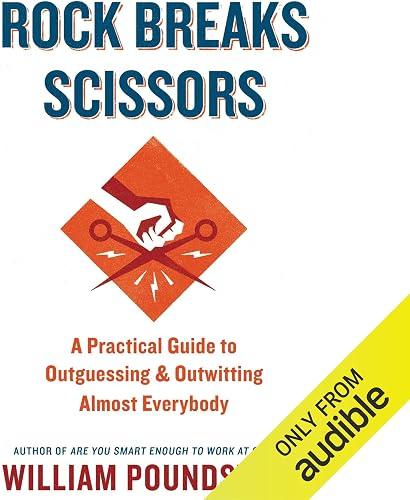
**Author:** William Poundstone
**Estimated Reading Time:** 45 minutes
**What You'll Learn:**
* Why humans are far more predictable than we believe * How to exploit predictable patterns in games, tests, sports, and finance * The psychology behind why we fail at randomness * Practical strategies for outguessing opponents in everyday situations * How to recognize when you are being outguessed
**Who This Book Is For:**
Anyone who makes decisions involving other people. That includes investors, sports fans, poker players, negotiators, test takers, password creators, and anyone curious about why human behavior follows hidden patterns. If you have ever tried to predict what someone else will do, this book will change how you think about that challenge.
Every day, you play games you do not realize you are playing. You try to predict whether a colleague will push back on your proposal. You guess which checkout line will move fastest. You decide whether to invest in a stock based on what other investors might do. You choose a password that no one else will guess. You attempt to anticipate whether your teenager is telling the truth. In each case, you are trying to outguess someone. And in each case, someone is trying to outguess you. William Poundstone's central insight is deceptively simple: humans are terrible at being random. We think we are unpredictable. We believe our choices are free and spontaneous. But when researchers study human behavior in controlled settings, they find the opposite. Our attempts at randomness follow patterns. Our "spontaneous" choices are shaped by unconscious biases. Our efforts to avoid predictability often make us more predictable. This book explores the science and psychology of outguessing. It draws on decades of research in psychology, statistics, game theory, and behavioral economics. It examines rock-paper-scissors tournaments, multiple-choice test design, lottery number selection, tennis serves, baseball pitches, financial fraud detection, and password cracking. In every domain, the same lesson emerges: people are mechanical in ways they do not perceive. The implications are profound. If you understand the patterns that govern human choice, you can predict what others will do. You can improve your odds in games of chance. You can make better guesses on tests. You can choose lottery numbers that, while no more likely to win, will earn you a larger share of the jackpot if they do. You can spot fraud in financial data. You can create passwords that are genuinely hard to crack. But the book also offers a warning. The same predictability that you can exploit in others also applies to you. Your choices are not as free as you think. Your attempts at randomness are not as random as you believe. The first step to outguessing others is…
Continue reading in the MinuteRead app
Get the complete 30-minute summary of Rock Breaks Scissors
Get the complete summary in the appHumans cannot generate random sequences. Our attempts at randomness follow predictable patterns.
The most common error is over-alternation. We avoid repeating ourselves too much.
People are predictable when trying not to be. This is the foundation of outguessing.
In rock-paper-scissors, novices favor rock. Exploit this tendency.
In multiple-choice tests, B is often correct in four-option questions. Avoid the previous correct choice.
In the lottery, choose unpopular numbers above 31. You will keep more of the jackpot if you win.
"Rock Breaks Scissors" is a strong fit if you want practical ideas around psychology, science, economics, especially themes like humans cannot generate random sequences. our attempts at randomness follow predictable patterns; the most common error is over-alternation. we avoid repeating ourselves too much. The MinuteRead summary distills these concepts into a focused read, whether you're deciding whether to buy the book or applying its lessons at work.
Motivated to help readers with all of us are constantly trying to predict the actions of others, William Poundstone wrote “Rock Breaks Scissors” to package those ideas for a fast, focused read. In “Rock Breaks Scissors”, William Poundstone focuses on all of us are constantly trying to predict the actions of others. Through “Rock Breaks Scissors”, William Poundstone distills the core ideas on psychology into lessons readers can absorb in a single short sitting. Readers turn to this work when they…
View all summaries by William PoundstoneContinue Reading
Access the complete 30-minute summary and thousands more nonfiction books in the MinuteRead app.

Continue reading the complete summary in the MinuteRead app.