MinuteRead
30 min
Book summary
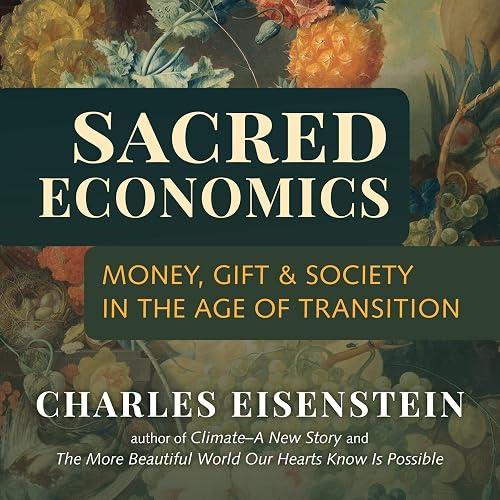
by Charles Eisenstein
Premium summary · Opens in the app · 30 min read
There is a quiet unease that runs through modern life, a feeling that something essential has been lost. We work harder than ever, yet struggle to find time for the people we love. We produce more goods than any civilization in history, yet poverty persists. We know more about the natural world than ever before, yet we continue to destroy it. At the center of all these contradictions sits something we rarely examine: money.
**Author:** Charles Eisenstein **Estimated Reading Time:** 45 minutes
**What You'll Learn:** How money shapes human relationships, why our current financial system creates scarcity and environmental destruction, and what a transformed economic system could look like. You will understand the hidden mechanics of interest, debt, and currency, and discover practical pathways toward a more connected and generous economy.
**Who This Book Is For:** Anyone who senses that something is deeply wrong with our economic system but cannot articulate exactly what. Readers who want to understand money not as a technical subject for specialists, but as a story we tell each other, a story that can be rewritten. This book is for those who believe that economics and ecology, money and meaning, are not separate domains.
There is a quiet unease that runs through modern life, a feeling that something essential has been lost. We work harder than ever, yet struggle to find time for the people we love. We produce more goods than any civilization in history, yet poverty persists. We know more about the natural world than ever before, yet we continue to destroy it. At the center of all these contradictions sits something we rarely examine: money. We treat money as if it were a force of nature, like gravity or weather. We speak of markets as if they were ecosystems, and of financial crises as if they were earthquakes. But money is not a natural phenomenon. It is a human creation, a system of agreements, a story we tell each other about what has value and what does not. And because it is a story, it can be changed. Charles Eisenstein wrote Sacred Economics to reveal the hidden architecture of our monetary system and to show how that architecture shapes nearly every aspect of our lives. The book argues that our current money system is not merely flawed in its details but is fundamentally misaligned with human nature and the nature of the planet. The way we create money, the way we charge interest, the way we treat the gifts of nature as commodities: all of these are choices, not inevitabilities. The problem Eisenstein identifies is not that we have too much money or too little, but that money has become a kind of false god. We have made it sacred in the wrong way. We have allowed it to stand outside the cycles of nature, immune to decay, accumulating without limit, and in doing so we have created an economy that must grow forever on a finite planet. This is the root of our ecological crisis, our social fragmentation, and our personal sense of emptiness. What makes Eisenstein's approach different is that he does not merely critique.…
Continue reading in the MinuteRead app
Get the complete 30-minute summary of Sacred Economics
Get the complete summary in the appMoney is a social agreement, not a natural phenomenon. It can be redesigned.
Interest creates a growth imperative that drives environmental destruction and inequality.
Negative-interest currency would encourage circulation, long-term thinking, and equitable distribution.
Scarcity is largely artificial. The Earth is abundant, and sharing creates more than hoarding.
The commons must be protected from enclosure and commodification.
Local economies build community and resilience.
"Sacred Economics" is a strong fit if you want practical ideas around economics, philosophy, politics, especially themes like money is a social agreement, not a natural phenomenon. it can be redesigned; interest creates a growth imperative that drives environmental destruction and inequality. The MinuteRead summary distills these concepts into a focused read, whether you're deciding whether to buy the book or applying its lessons at work.
Motivated to help readers with money is a system of social agreements, Charles Eisenstein wrote “Sacred Economics” to package those ideas for a fast, focused read. In “Sacred Economics”, Charles Eisenstein focuses on money is a system of social agreements. Through “Sacred Economics”, Charles Eisenstein distills the core ideas on economics into lessons readers can absorb in a single short sitting. Readers turn to this work when they want Charles Eisenstein's perspective on the subject without wor…
Continue Reading
Access the complete 30-minute summary and thousands more nonfiction books in the MinuteRead app.

Continue reading the complete summary in the MinuteRead app.