MinuteRead
30 min
Book summary
Premium summary · Opens in the app · 5 min read
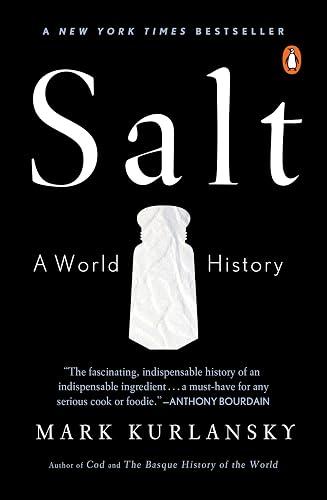
Salt: A World History explores how the everyday mineral we know as table salt has shaped human civilization through the centuries, causing wars and the rise and fall of empires.
Salt: A World History explores how the everyday mineral we know as table salt has shaped human civilization through the centuries, causing wars and the rise and fall of empires.
Many years ago in a mountain mine, near the Austrian border, a perfectly preserved body was found – salted like a codfish. Resting close to the town of Salzburg, which translates to ‘salt castle,’ the body was colorfully dressed and identified as an ancient salt miner, dating back to about 400 B.C. This well-preserved corpse later proved to be an ancient Celt.
Deriving their name from the Greek word ‘hal,’ which means salt, Greek and Roman historians described the Celts as huge, terrifying men in bright fabrics. Since the guardians of their culture, the Druids, did not keep written records, we know little about them. But we do know they thrived on salt.
In the salty miner’s time, Celtic territory spanned huge areas of Europe. The Celts became very wealthy by trading salt and salted goods, including salt-cured ham.
They were also responsible for developing innovative techniques for mining the precious mineral. For example, they discovered the advantage of using bronze mining tools rather than iron ones. Who would’ve thought that bronze does not rust? The Celts, apparently!
Alas, despite their success as innovators, shrewd traders, engineers and formidable warriors, their time in history ran its course and they were eventually dominated by Julius Caesar’s Roman forces in 50 B.C..
After the fall of the Roman empire, Venice and Genoa remained influential in the business of salt. Eventually, new trade routes to India and the New World popped up. However, since the early colonists in America included self-reliant fishermen, they started to rely on salt trade less and less. They began to harvest it for themselves. Of course, the British did not want self-reliant colonists. Hence, they made “British salt” less expensive in an effort to damage local business. They also continued to raise the taxes on salt and imposed punitive tariffs to further control the market. Arguments turned into conflicts, which eventually exploded into the American Revolutionary War in 1775. To weaken the rebels further, Britain completely cut off the export of salt to the colonies. In the end, the colonists prevailed. America was acknowledged as an independent nation in 1783, but it all started with salt. Salt continued to play a role in the young United States. Despite having recognized the colonist’s independence, Britain initially restricted U.S. trade. This inspired a new conflict, in which the British attempted to destroy all the newly created saltworks in America. But the colonists were clever. They had built covert saltworks and canals to facilitate salt transport. Once the war ended in…
Continue reading in the MinuteRead app
Get the complete 5-minute summary of Salt: A World History
Get the complete summary in the appThe Celts were a wealth ancient people, yet few know that their success was built on salt.
By restricting trade and attacking their saltworks, Britain triggered the American revolutionary war.
Brine extraction caused homes to sink and railroad tracks to buckle, but the resulting damages tax only empowered big players.
"Salt: A World History" is a strong fit if you want practical ideas around culture, history, society, especially themes like the celts were a wealth ancient people, yet few know that their success was built on salt; by restricting trade and attacking their saltworks, britain triggered the american revolutionary war. The MinuteRead summary distills these concepts into a focused read, whether you're deciding whether to buy the book or applying its lessons at work.
Mark Kurlansky is a New York Times bestselling and James A. Beard Award-winning author. He is the recipient of a Bon Appétit American Food and Entertaining Award for Food Writer of the Year, and the Glenfiddich Food and Drink Award for Food Book of the year. Photo by Wes Washington (Own work) [CC BY-SA 3.0 (http://creativecommons.org/licenses/by-sa/3.0)], via Wikimedia Commons.
View all summaries by Mark KurlanskyContinue Reading
Access the complete 5-minute summary and thousands more nonfiction books in the MinuteRead app.

Continue reading the complete summary in the MinuteRead app.