MinuteRead
30 min
Book summary
by Michael Moss
Premium summary · Opens in the app · 5 min read
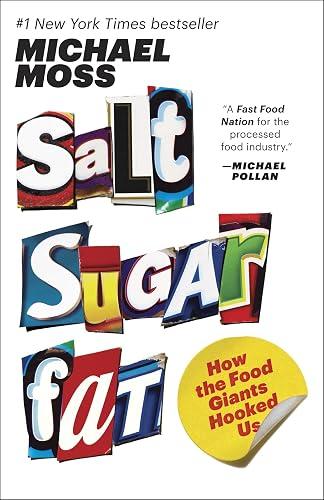
Salt Sugar Fat takes you through the history of the demise of home-cooked meals by explaining why you love salt, sugar and fat so much and how the processed food industry managed to hook us by cramming all 3 of those into their products.
Salt Sugar Fat takes you through the history of the demise of home-cooked meals by explaining why you love salt, sugar and fat so much and how the processed food industry managed to hook us by cramming all 3 of those into their products.
Gary Vaynerchuk always says marketers ruin everything. He’s right.
In the 1950s, for the first time women in America started taking jobs and creating careers of their own on a big scale. That of course meant more wealth and made the US prosper, but it also meant less time for cooking.
Additionally, TV had just been invented, so naturally all eyes were glued to it – who’d want to miss Bonanza, Lassie or Tom & Jerry for boiling potatoes?
So why not spend some of their hard-earned money on convenience foods, Americans thought.
But don’t think there wasn’t any resistance. 25,000 teachers at the time taught a subject that is unheard of today: home economics.
Yes, learning how to cook and manage a household was taught in school once. Why did we do away with one of the most useful subjects?
I know I could’ve used some cooking skills prior to moving out.
But marketers are smart, and so they hired some of those home economics teachers and started educating Americans about the ease of processed meals.
This resulted in fictional teachers, like Betty Crocker, who ended up promoting heat-and-serve meals across the entire nation with cookbooks, classes, TV shows, catchy slogans and even showrooms.
The combined power of being busy, TV and the heavily marketed faces of convenient cooking eventually overpowered the home-cooked meal and took its place, and it hasn’t given it back until today.
From an evolution standpoint, our bodies have developed to crave sugar. It gives us a short energy boost, which, back in ancient could save our lives. Today, however, we should treat it like a drug. We all have way too much of it because it’s in everything. You know what’s worse? Fat. Fat has twice as many calories as sugar, taken gram for gram. Why do we love it so much? We don’t have a built-in limit for fat. We have taste buds for salt and sugar but not for fat. Unlike sugar or salt (which has an interesting history on its own, btw), you can never have too much fat. More is always better. At least that’s what your body thinks. Since all we do is sense its texture (which we love), we suck at estimating how much fat is in food and whether we’ve had enough of it already. And while there are good fats, we usually have more of the bad ones (surprise). Even worse, add…
Continue reading in the MinuteRead app
Get the complete 5-minute summary of Salt Sugar Fat
Get the complete summary in the appTV, jobs and smart advertising marked the downfall of home-cooked meals.
You eat 50% more fat than you should and it’s because you can’t taste it.
It’s not the food industry’s fault that it offers so many bad foods – it’s yours.
"Salt Sugar Fat" is a strong fit if you want practical ideas around culture, education, fitness, especially themes like tv, jobs and smart advertising marked the downfall of home-cooked meals; you eat 50% more fat than you should and it’s because you can’t taste it. The MinuteRead summary distills these concepts into a focused read, whether you're deciding whether to buy the book or applying its lessons at work.
Michael Moss was awarded the Pulitzer Prize for Explanatory Reporting in 2010, and was a finalist for the prize in 2006 and 1999. He is also the recipient of a Gerald Loeb Award and an Overseas Press Club citation. Before coming to The New York Times, he was a reporter for The Wall Street Journal, New York Newsday, and The Atlanta Journal-Constitution. He has been an adjunct professor at the Columbia School of Journalism and currently lives in Brooklyn with his wife and two sons. Bio from Wikip…
View all summaries by Michael MossContinue Reading
Access the complete 5-minute summary and thousands more nonfiction books in the MinuteRead app.

Continue reading the complete summary in the MinuteRead app.