MinuteRead
30 min
Book summary
by Allen Frances
Premium summary · Opens in the app · 30 min read
Something strange has happened to the way we think about mental health. Over the past few decades, the line between normal human suffering and mental illness has blurred beyond recognition. Experiences that were once considered part of life, grief after loss, shyness in social situations, difficulty focusing on boring tasks, childhood temper tantrums, have been transformed into psychiatric diagnoses requiring treatment.
**Author:** Allen Frances
**Estimated Reading Time:** 45 minutes
**What You'll Learn:**
- Why the boundaries of mental illness have expanded so dramatically - How diagnostic inflation harms individuals and society - The role of pharmaceutical companies in creating "diseases" - What fad diagnoses reveal about psychiatric trends - How to protect yourself and your loved ones from overdiagnosis - What good psychiatric care actually looks like
**Who This Book Is For:**
Anyone who has ever wondered whether their sadness, anxiety, or difficulty concentrating is normal. Anyone who has been diagnosed with a mental disorder and questioned whether the label fits. Anyone concerned about the rising rates of psychiatric diagnosis in children and adults. And anyone who wants to understand how the mental health system works, why it often fails, and what can be done to fix it.
Something strange has happened to the way we think about mental health. Over the past few decades, the line between normal human suffering and mental illness has blurred beyond recognition. Experiences that were once considered part of life, grief after loss, shyness in social situations, difficulty focusing on boring tasks, childhood temper tantrums, have been transformed into psychiatric diagnoses requiring treatment. The numbers tell a startling story. In 1980, when the third edition of the Diagnostic and Statistical Manual of Mental Disorders was published, approximately one in every 184 Americans qualified for a mental disorder. By the time the fourth edition appeared in 1994, that number had jumped to one in every 100. Today, estimates suggest that nearly one in four adults, and one in five children, carries a psychiatric diagnosis. The pool of normality is shrinking into a mere puddle. Allen Frances is uniquely positioned to tell this story. As the chair of the task force that created the DSM-IV, he helped write the very manual that expanded psychiatric diagnosis in the 1990s. He knows the system from the inside, its strengths, its flaws, and its unintended consequences. And he has spent the years since watching with growing alarm as the diagnostic categories he helped create were stretched far beyond their intended boundaries. The problem is not that mental illness does not exist. It does, and it causes immense suffering. The problem is that psychiatry has become too good at finding illness everywhere it looks. The diagnostic net has been cast so wide that it now captures millions of people who are simply experiencing the normal difficulties of being human. And once caught in that net, people are often treated with medications they do not need, for conditions they do not have, with consequences that can last a lifetime. Frances calls this phenomenon diagnostic inflation. It is the gradual expansion of psychiatric…
Continue reading in the MinuteRead app
Get the complete 30-minute summary of Saving Normal
Get the complete summary in the appThe boundaries of mental illness have expanded dramatically, shrinking the pool of normality into a puddle.
Psychiatric diagnosis is shaped by culture, economics, and professional ambition, not just science.
Pharmaceutical companies have a financial interest in expanding the definition of mental illness.
Fad diagnoses come and go, leaving behind misdiagnosis and unnecessary treatment.
An inaccurate diagnosis can wreck a life, causing harm through unnecessary treatment, labeling, and stigma.
Grief, sadness, anxiety, and difficulty concentrating are often normal responses to life's challenges, not symptoms of i
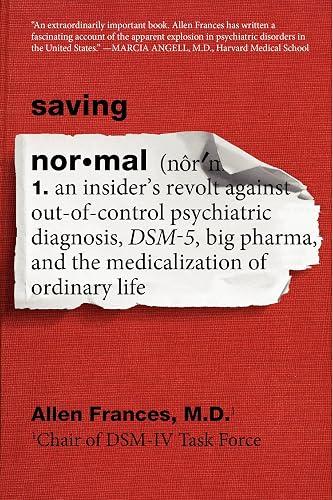
"Saving Normal" is a strong fit if you want practical ideas around psychology, mental illness, medicine, especially themes like the boundaries of mental illness have expanded dramatically, shrinking the pool of normality into a puddle; psychiatric diagnosis is shaped by culture, economics, and professional ambition, not just science. The MinuteRead summary distills these concepts into a focused read, whether you're deciding whether to buy the book or applying its lessons at work.
Motivated to help readers with the pool of normality is shrinking into a mere puddle, Allen Frances wrote “Saving Normal” to package those ideas for a fast, focused read. In “Saving Normal”, Allen Frances focuses on the pool of normality is shrinking into a mere puddle. Through “Saving Normal”, Allen Frances distills the core ideas on psychology into lessons readers can absorb in a single short sitting. Readers turn to this work when they want Allen Frances's perspective on the subject without w…
Continue Reading
Access the complete 30-minute summary and thousands more nonfiction books in the MinuteRead app.

Continue reading the complete summary in the MinuteRead app.