MinuteRead
30 min
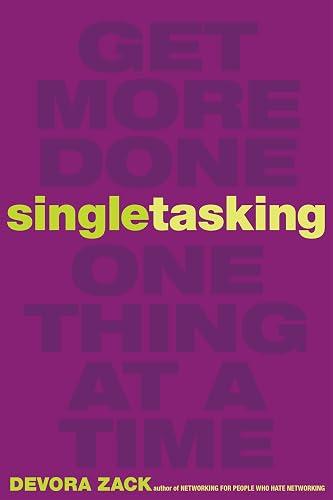
Book summary
by Devora Zack
Premium summary · Opens in the app · 5 min read
Singletasking digs into neuroscientific research to explain why we’re not meant to multitask, how you can go back to the old, singletasking ways, and why that’s better for your work, relationships and happiness.
Singletasking digs into neuroscientific research to explain why we’re not meant to multitask, how you can go back to the old, singletasking ways, and why that’s better for your work, relationships and happiness.
One day I almost crashed my parents’ car, because I was fumbling around with my phone and not looking at the road. While that was a good (and probably necessary) lesson, I don’t recommend learning it the hard way.
Studies have found that being on the phone while driving is just as bad as being drunk behind the wheel. Combined with the fact that 70% of all drivers do use their phones while maneuvering through traffic, this becomes a scary statistic. In fact, at any given moment during daylight hours, around 6% of people are using a cell phone, which is as if every 17th car you see in traffic has a drunk behind the wheel.
This adds up. Around 17% of all car crashes are a direct result of distracted driving, racking up $175 billion each year in economic and societal costs. This makes multitasking the second biggest source of roadkills and car crashes in the US.
Oh, and guess what number one is: drunk driving.
What makes multitasking complex and a tough problem to crack is that it’s not just one habit. It’s not like you can “stop multitasking” from one day to the next, because it’s a combination of many small things that you do, which, in total, add up. The only way to really learn to become a singletasker is to combine many hacks, techniques, and small habit changes over time, which will gradually turn you into a very focused person. Two of these changes Devora suggests are: Cluster tasking. By simply batching similar tasks, you can save a lot of mental capacity, because you’re repeating the same thing again and again. For example, I only do my coaching calls on Thursdays and Fridays, to make sure I can spend the other days creating. You could batch writing-related tasks, like answering email and writing protocols, into one block, talking-related activities like calls and meetings into another, and physical work, for example at home, into another. Leaving buffers in your schedule. Doctors always have two 30-minute slots each day, which they keep empty, in case emergencies turn up. If you pack your schedule too tightly, it’s only a matter of time until you fall behind. By keeping a buffer you account for sudden changes and unpredictable tasks, and can still finish everything without having to rush and do multiple things at once. Note: For 32 more of these (which, if all combined, really add up), you can check out the massive guide to help…
Continue reading in the MinuteRead app
Get the complete 5-minute summary of Singletasking
Get the complete summary in the appMultitasking is as bad as being drunk, and costs the US $175 billion a year.
The more hacks and techniques you combine, the longer you can singletask.
Singletasking won’t just make you more productive, it’ll also make you happier.
"Singletasking" is a strong fit if you want practical ideas around culture, entrepreneurship, happiness, especially themes like multitasking is as bad as being drunk, and costs the us $175 billion a year; the more hacks and techniques you combine, the longer you can singletask. The MinuteRead summary distills these concepts into a focused read, whether you're deciding whether to buy the book or applying its lessons at work.
Motivated to help readers with singletasking digs into neuroscientific research to explain why we’re not meant to multitask, Devora Zack wrote “Singletasking” to package those ideas for a fast, focused read. In “Singletasking”, Devora Zack focuses on singletasking digs into neuroscientific research to explain why we’re not meant to multitask. Through “Singletasking”, Devora Zack distills the core ideas on entrepreneurship into lessons readers can absorb in a single short sitting. Readers turn to…
View all summaries by Devora ZackContinue Reading
Access the complete 5-minute summary and thousands more nonfiction books in the MinuteRead app.

Continue reading the complete summary in the MinuteRead app.