MinuteRead
30 min
Book summary
Premium summary · Opens in the app · 30 min read
There is a moment in every meaningful conversation when something shifts. A person who was certain they could not change suddenly sees a possibility they had never considered. A client who believed they were fundamentally broken glimpses a version of themselves that is whole. A leader who thought their team was resistant discovers that the problem was never motivation but meaning.
**Author:** Robert B. Dilts
**Estimated Reading Time:** 45 minutes
**What You'll Learn:**
- How language shapes beliefs, perceptions, and reality itself - The hidden structure behind every belief you hold - Specific verbal patterns that can transform limiting beliefs into empowering ones - How to recognize and neutralize "thought viruses" that sabotage growth - A systematic approach to using language for profound personal change
**Who This Book Is For:**
This book is for anyone who has ever felt trapped by a belief they could not shake. It is for coaches, therapists, leaders, and communicators who want to help others see beyond their current limitations. It is for curious minds who sense that words carry far more power than we typically acknowledge. If you have ever wondered why some conversations change everything while others change nothing, this book will show you the mechanics behind that difference.
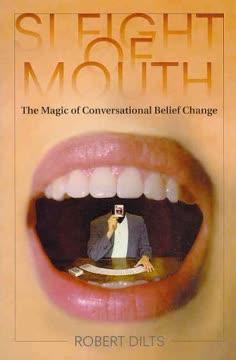
There is a moment in every meaningful conversation when something shifts. A person who was certain they could not change suddenly sees a possibility they had never considered. A client who believed they were fundamentally broken glimpses a version of themselves that is whole. A leader who thought their team was resistant discovers that the problem was never motivation but meaning. Most of us have experienced these moments. Few of us understand what actually happened. Robert Dilts has spent decades studying the precise linguistic mechanisms that make such transformations possible. His book, Sleight of Mouth, is an exploration of how language operates at the deepest levels of human experience. The title itself is a play on words. A "sleight of hand" is a magician's trick, a manipulation of perception that creates an illusion. But "sleight of mouth" is something far more profound. It is the art of using language not to deceive, but to reveal. Not to manipulate, but to liberate. The premise is simple and radical. Words and magic were once the same thing. In ancient traditions, to name something was to have power over it. The right words, spoken at the right time, could heal the sick, curse the wicked, or bless the worthy. We have largely lost this understanding. We treat language as a mere tool for describing reality, forgetting that language also creates reality. Consider what happens when a doctor tells a patient they have six months to live. The words are not merely descriptive. They reshape the patient's entire experience of time, of their body, of their relationships, of what is possible. The words become part of the illness itself. Or consider what happens when a teacher tells a student they have a gift for mathematics. The words do not simply report an observation. They create an expectation, a sense…
Continue reading in the MinuteRead app
Get the complete 30-minute summary of Sleight of Mouth
Get the complete summary in the appLanguage shapes reality. The words you use create the world you experience.
Every belief has a structure: a complex equivalence (A equals B) or a cause-effect relationship (A causes B).
Every limiting belief serves a positive intention. Find the intention, and you find the key to change.
Reframing changes meaning without changing events. Change the frame, and you change the experience.
Expectations create self-fulfilling prophecies. What you expect shapes what you do and what you experience.
Belief change follows a natural cycle: wanting, openness, believing, doubt, remembering, trust.
"Sleight of Mouth" is a strong fit if you want practical ideas around psychology, communication, personal development, especially themes like language shapes reality. the words you use create the world you experience; every belief has a structure: a complex equivalence (a equals b) or a cause-effect relationship (a causes b). The MinuteRead summary distills these concepts into a focused read, whether you're deciding whether to buy the book or applying its lessons at work.
Robert Dilts is a prominent figure in neuro-linguistic programming (NLP), having been involved since its inception in 1975. He has made significant contributions to the field, particularly in the areas of beliefs and strategies. Dilts is known for authoring the Encyclopedia of Systemic NLP and has developed numerous educational software programs. In 1981, he co-founded a software company called Behavioral Engineering, where he created programs like Math and Spelling Strategy, which were later li…
View all summaries by Robert B. DiltsContinue Reading
Access the complete 30-minute summary and thousands more nonfiction books in the MinuteRead app.

Continue reading the complete summary in the MinuteRead app.