MinuteRead
30 min
Book summary
by Paul Babiak
Premium summary · Opens in the app · 30 min read
Every workplace has its difficult personalities. The colleague who takes credit for your work. The manager who lies without blinking. The executive who charms the board while terrorizing subordinates. Most people dismiss these individuals as merely ambitious, politically savvy, or socially awkward. We tell ourselves that truly dangerous people are rare, that they exist in prisons and crime statistics, not in corner offices and boardrooms.
**Author:** Paul Babiak
**Estimated Reading Time:** 45 minutes
**What You'll Learn:** How psychopaths operate in corporate environments, why they succeed despite causing immense harm, how to recognize their tactics, and what you can do to protect yourself and your organization.
**Who This Book Is For:** Professionals who want to understand workplace manipulation, leaders responsible for hiring and culture, employees who suspect they are dealing with a toxic colleague or boss, and anyone interested in the hidden dynamics of corporate power.
Every workplace has its difficult personalities. The colleague who takes credit for your work. The manager who lies without blinking. The executive who charms the board while terrorizing subordinates. Most people dismiss these individuals as merely ambitious, politically savvy, or socially awkward. We tell ourselves that truly dangerous people are rare, that they exist in prisons and crime statistics, not in corner offices and boardrooms. Paul Babiak's research suggests otherwise. When he began studying the intersection of psychology and corporate behavior, he discovered something unsettling. The very traits that define psychopathy, charm, manipulation, lack of empathy, and ruthless self-interest, are not only present in corporate environments but are often rewarded there. The numbers are striking. While approximately 1 percent of the general population meets the clinical threshold for psychopathy, studies of corporate environments suggest the rate among senior executives may be closer to 3.5 percent. This is not a coincidence. The corporate world, with its emphasis on charisma, confidence, and results, creates an environment where psychopathic traits can flourish. The predators have found a hunting ground where the prey is plentiful and the camouflage is built into the culture. The problem is that most people do not know how to recognize psychopathic behavior outside of criminal contexts. We expect psychopaths to look like movie villains, cold-eyed and obviously dangerous. The reality is far more subtle. Corporate psychopaths are often the most charming people in the room. They are the ones who make you feel special, who seem to understand exactly what you want to hear, who project an image of competence and vision that others find magnetic. This book exists because the gap between perception and reality is where the damage happens. By the time most people realize they are dealing with a psychopath, the manipulation has already occurred. Careers have been derailed. Reputations have been destroyed. Organizations have been hollowed out from within. Babiak's approach is different from typical business books about difficult people. He does not offer simplistic advice about avoiding toxic coworkers or managing difficult bosses. Instead, he provides a clinical understanding of how psychopaths actually operate, drawn from decades of research and case studies. He explains the assessment phase, where psychopaths identify potential targets. He reveals…
Continue reading in the MinuteRead app
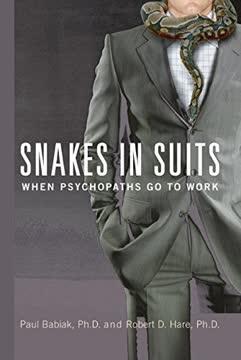
Get the complete 30-minute summary of Snakes in Suits
Get the complete summary in the appPsychopaths are present in corporate environments at higher rates than in the general population.
Psychopaths are skilled at hiding their true nature behind a charming, confident persona.
Psychopaths follow a predictable pattern: assessment, manipulation, and abandonment.
Confidence is not competence. Charm is not character.
Organizations that reward charisma over substance are more vulnerable to psychopathic infiltration.
Document everything. Records protect you from false accusations and gaslighting.
"Snakes in Suits" is a strong fit if you want practical ideas around psychology, business, science, especially themes like psychopaths are present in corporate environments at higher rates than in the general population; psychopaths are skilled at hiding their true nature behind a charming, confident persona. The MinuteRead summary distills these concepts into a focused read, whether you're deciding whether to buy the book or applying its lessons at work.
Dr. Paul Babiak is a renowned psychologist and expert in the field of corporate psychopathy. He has extensively researched and written about the presence of psychopaths in the business world. Babiak is known for his work on developing assessment tools to identify psychopathic traits in workplace settings. He has collaborated with Dr. Robert D. Hare, creator of the Psychopathy Checklist, to study how psychopaths operate in corporate environments. Babiak's expertise has been sought by various orga…
View all summaries by Paul BabiakContinue Reading
Access the complete 30-minute summary and thousands more nonfiction books in the MinuteRead app.

Continue reading the complete summary in the MinuteRead app.