MinuteRead
30 min
Book summary
by Gary Klein
Premium summary · Opens in the app · 30 min read
For decades, the study of decision-making was dominated by a simple assumption: rational analysis is the gold standard. Researchers built elegant models showing how people should weigh options, calculate probabilities, and select the choice with the highest expected utility. The problem was that almost nobody actually decided that way in the real world.
**How People Make Decisions**
_by Gary Klein_
**Estimated Reading Time:** 2 hours 45 minutes
**What You'll Learn**
- Why intuition is not magic but a trainable skill built through experience - How firefighters, nurses, pilots, and military commanders make life-or-death decisions in seconds - The Recognition-Primed Decision model that explains expert judgment - How mental simulation lets you evaluate options without comparing alternatives - Why rational analysis often fails in real-world settings - Practical techniques like the PreMortem to improve team decisions - How to communicate intent so others can act intelligently without constant instructions
**Who This Book Is For**
This book is for anyone who makes decisions under pressure. It is for leaders who want to understand why their experienced people sometimes just know what to do. It is for professionals who have been told to follow analytical decision frameworks that never quite fit reality. It is for anyone curious about how the mind actually works when the stakes are high, time is short, and information is incomplete.
For decades, the study of decision-making was dominated by a simple assumption: rational analysis is the gold standard. Researchers built elegant models showing how people should weigh options, calculate probabilities, and select the choice with the highest expected utility. The problem was that almost nobody actually decided that way in the real world. Gary Klein spent years watching people make decisions in settings where the consequences of failure were severe. He studied firefighters entering burning buildings, nurses in neonatal intensive care units, tank commanders in battle, pilots facing emergencies, and offshore oil rig workers responding to crises. What he found contradicted much of what academic psychology had been teaching. These professionals rarely compared options. They did not generate lists of alternatives and evaluate each one systematically. Instead, they looked at a situation, recognized it as familiar, and knew what to do. Often they could not explain how they knew. The answer just appeared. This book is the result of decades of research into what Klein calls naturalistic decision-making. It is the study of how people actually decide in real settings, not in laboratories. The findings are both surprising and deeply practical. Intuition, it turns out, is not a mysterious gift possessed by a lucky few. It is a form of expertise. It is pattern recognition built through experience. And it can be studied, understood, and developed. The implications are enormous. If intuition is a skill rather than a mystical force, then organizations can train it. If experts see the world differently, then we can learn what they see. If rational analysis has limits, then we can stop forcing people to use tools that do not fit their situations. Klein's work also…
Continue reading in the MinuteRead app
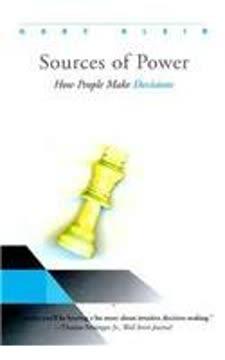
Get the complete 30-minute summary of Sources of Power, 20th Anniversary Edition
Get the complete summary in the appIntuition is pattern recognition built through experience, not a mysterious gift.
Experts see cues and patterns that novices cannot see.
The Recognition-Primed Decision model: recognize the situation, generate one option, evaluate through mental simulation.
Mental simulation is how experts test actions without trying them.
Stories are powerful tools for storing and sharing expertise.
Rational analysis has limits. Use it for well-structured problems, not complex real-world decisions.
"Sources of Power, 20th Anniversary Edition" is a strong fit if you want practical ideas around psychology, business, leadership, especially themes like intuition is pattern recognition built through experience, not a mysterious gift; experts see cues and patterns that novices cannot see. The MinuteRead summary distills these concepts into a focused read, whether you're deciding whether to buy the book or applying its lessons at work.
Gary A. Klein , Ph.D., is a renowned cognitive psychologist and pioneer in naturalistic decision-making. He developed influential models like the Recognition-Primed Decision (RPD) model and the Data/Frame model of sensemaking. Klein founded Klein Associates in 1978, which grew significantly before he sold it in 2005. He later established ShadowBox LLC in 2014. Klein has authored five books and is known for innovative methods such as Cognitive Task Analysis and the PreMortem risk assessment techn…
View all summaries by Gary KleinContinue Reading
Access the complete 30-minute summary and thousands more nonfiction books in the MinuteRead app.

Continue reading the complete summary in the MinuteRead app.